DIGITAL EXHIBITIONS2


傳統與至善
TRADITION & PERFECTION
PAPER CUTTINGS
FROM CHINA AND SWITZERLAND
中瑞剪藝對話
Curated by Dr Harald P. Kraemer
Edited by Christopher Mattison
Translated by Kitty Lam
Website designed by Susana Lam
策展人:孔慧銳博士
文字編輯:馬德松
文字翻譯:林慧琳
網站設計:林采琪
Foreword
前言
Paper cuttings have long fascinated viewers with their expressive storytelling and precision. For the first time, Swiss paper cuttings from the Wyss Collection (Unterseen, Bern) are being juxtaposed with Chinese paper cuttings from the collection of the University Museum and Art Gallery, The University of Hong Kong, along with works from the Guangling Paper Cutting Art Museum and the Jieyiyuan Paper Cutting Art Center, Pingyao, both located in Shanxi province. The aim of the exhibition is to highlight the diversity and distinctive cultural identities of this fascinating art form. In 2009, Chinese paper cutting was added to UNESCO’s Representative List of the Intangible Cultural Heritage of Humanity. To highlight the significance of this craft spanning both cultures, two parallel exhibitions will be held in spring 2026, at the University Museum and Art Gallery and the Kunsthaus Interlaken (22 February–17 May 2026).
Swiss paper cuttings are primarily narrative works. From the mid-19th century onwards, they replaced the popular shadow pictures known as silhouettes, with a particular focus on Alpine life. Swiss paper cuttings function as condensed narrative microcosms, each distinguished by striking and subtle variations in their repertoire of figures, forms, and designs. Cut from black paper and arranged largely symmetrically, Swiss paper cuttings feature a wealth of ornamentation and an incredible density of detail that invites viewers to discover and linger. Thanks to the cooperation of the Wyss Collection this exhibition will feature works by pioneers such as Johann Jakob Hauswirth and Louis Saugy; traditional cuttings by David Regez and Christian Schwizgebel; and contemporary constructions from Ueli Hofer, Martha Kneusslin, Nelly Naef, Ernst Oppliger, Bruno Weber, and others.
Chinese paper cuttings differ from Swiss paper cuttings in their use of color and tendency to appear in series. Since red promises good luck, most Chinese paper cuttings are created from red paper and produced in sets. Packaged in small folders, they present variations on a subject or theme—tigers or peacocks, Beijing opera masks, views of pagoda towers, or the scenic beauty of a particular region. Another defining characteristic is their strong symbolism and iconography. For example, a pine tree in combination with a crane can symbolize longevity, representing wishes for health in old age and a lasting marriage. Chinese paper cuttings also tell stories, depicting scenes from well-known tales or presenting instructive narratives.
The exhibition begins with a historical overview of the development of paper cutting in Switzerland and China, then showcases the diversity of works through dialogical and thematic comparisons. We invite you to discover and compare these magnificent works of cultural heritage from Switzerland and China.
剪紙藝術憑藉其生動的敘事手法與精湛的技藝,歷來吸引着觀者目光。本次展覽首次將來自Wyss收藏(伯恩州,下塞恩)的瑞士剪紙作品,與香港大學美術博物館館藏的中國剪紙、中國廣靈剪紙藝術博物館及平遙縣花園街傑藝苑剪紙服務中心的作品並置展陳。意在突顯這迷人藝術形式的多樣性及文化獨特性。中國剪紙於2009年被列入聯合國教科文組織「人類非物質文化遺產代表作名錄」。為彰顯這項工藝跨越雙文化的非凡價值,兩場展覽在2026年春季,分別於香港大學美術博物館及Kunsthaus Interlaken(2026年2月22日至5月17日)平行展出。
瑞士剪紙是一門敘事的藝術。自十九世紀中葉,它便逐步取代了廣受歡迎的剪影,轉而以阿爾卑斯山區生活為創作核心。瑞士剪紙猶如凝縮的敘事微觀世界,透過其人物、形式和圖案組合,呈現出既鮮明又細膩的變化。作品多以黑紙剪成,構圖講究對稱,裝飾繁複瑰麗,細節密佈如織,引領觀者沉浸其中,細細尋味。承蒙Wyss收藏的鼎力合作,本展將展出Johann Jakob Hauswirth及Louis Saugy,這兩位藝術先鋒的代表作品;傳統剪紙藝術家David Regez及Christian Schwizgebel的作品;以及Ueli Hofer、Martha Kneusslin、Nelly Naef、Ernst Oppliger及Bruno Weber等當代剪紙藝術家的創新構思。
與瑞士剪紙相異,中國剪紙講究設色,由於紅色象徵吉祥喜慶,其創作多以紅紙為材,且常以系列形式出現。這些剪紙收納於小巧的冊頁中,展現出豐富多元的題材——例如猛虎與孔雀的雄姿、京劇臉譜的韻味、寶塔樓閣的多面風貌、以及各地獨特的山水風光。另一顯著特徵在於其濃厚象徵意義與圖像語言,作品往往蘊含着更深層的寓意。例如松鶴組合常寄寓長壽,既祝福晚年健康長壽,也祈願婚姻長久美滿。此外,中國剪紙亦同樣兼具敘事功能,不僅能再現經典故事場景,亦常透過視覺敘事傳遞教化意義。
本展將首先概述瑞士與中國剪紙的歷史發展進程,繼而透過展品間的對話與主體形式的對照,展現兩地作品的多元面貌。我們誠摯邀請您前來探索並對照這些來自瑞士和中國的壯麗文化遺產。


Left:
Galloping Horses with the Character(馬)
for the Year of the Horse
Nick Tsao
2026
26.5 x 21.5 cm
左邊:
馬到成功——馬年剪紙
曹晉愷
2026年
26.5 x 21.5 厘米
Right:
Horses
Hou Quanying
2026
29 x 29 cm
右邊:
馬
侯全英
2026年
29 x 29 厘米
From China to Europe
從中國到歐洲
The art of paper cutting has been passed down in northern China for approximately 2,000 years. It was the invention of paper, attributed to the official Cai Lun, who first recorded the method of paper production in 105 CE, that contributed to the spread of paper cutting. About a hundred years later, papers were dyed, and this colored paper was used to make figures for shadow theatre productions. However, the custom of paper cutting only became widespread during the Ming dynasty (1368–1644), reaching its peak during the reign of Emperor Guangxu of the Qing dynasty (1644–1912). The fact that the materials were inexpensive and that no training was required to learn the technique contributed significantly to its popularity, especially among the women in the Chinese rural population.
剪紙藝術在中國北方已傳承近兩千年。其得以普及,實賴東漢宦官蔡倫於公元105年首次記載造紙之法,使紙張的發明真正推動了這門技藝的普及。約百年後,彩色紙張出現,並被用於製作皮影戲人偶。然而,剪紙習俗直至明朝(1368–1644年)才被廣泛流傳,並在清朝光緒年間(1644–1912年)達到高峰。材料價格低廉且無需複雜訓練的特點,使剪紙尤其受到中國農婦的歡迎。
Pioneers
開拓者
01
As trade along the Silk Road increased, colored paper and the art of paper cutting eventually reached the Middle East and appeared in Europe for the first time in the 17th century. Amsterdam developed into a center for this new technique of “knipsels,” as paper cuttings are called in Holland. In our exhibition, the filigree basket made in 1773 by Albertus Cerbrand REESEN represents this early phase.
隨着絲綢之路貿易的興盛,彩色紙張與剪紙藝術最終傳入至中東地區,並於17世紀首次出現在歐洲。阿姆斯特丹逐漸發展成為「knipsels」(荷蘭對剪紙藝術的稱呼)這一種新技藝的中心。展覽中,Albertus Cerbrand REESEN於1773年創作的花絲工藝籃子剪紙作品,正是這一早期階段的代表。

Basket with Ducks and Rabbits
Albertus Cerbrand Reesen (Holland)
1773
Early folding cut
14 x 9.7 cm
籃中鴨兔
Albertus Cerbrand Reesen(荷蘭)
1773年
早期折疊剪紙
14 x 9.7 厘米
SWISS PAPER CUTTING
瑞士剪紙
The so-called lace pictures, lovingly and mass-produced primarily by nuns in the 18th and 19th centuries, are made from white parchment paper and serve as ornamental frames for a central image. This image, usually a watercolor, often depicts a saint like Santa Barbara, as on display in the exhibition.
In Switzerland at that time, Geneva, linked to Holland through Calvinism, was a major center of early paper cutting. The white cut with the title Sheep Grazing by Jean HUBER (1721–1786) is a typical motif of that period in the 18th century. Created around the same time as the early Biedermeier cuttings and dated to 1801, this landscape scenery by Antoinette Lisette FÄSI anticipates some of the characteristics that would later define the Swiss tradition. Around 50 years after Fäsi, Johann Jakob HAUSWIRTH (1809–1871) created a work that continues to influence Swiss paper cutting to this day. The innovations and motifs of this “undisputed creator of the original traditional Swiss” style were adopted, varied, and ultimately led to independent ideas by later generations.
所謂的「蕾絲畫」,是指那些於18至19世紀由修女們傾心大量製作、以白色羊皮紙剪製成,並作為中心圖案裝飾性邊框的作品。該中央圖像多為水彩畫,並常描繪聖人形象,例如本展覽中呈現的聖芭芭拉作品。
與此同時在瑞士,因加爾文主義而與荷蘭有緊密聯繫的日內瓦,成為了早期剪紙藝術的重要中心。Jean HUBER(1721–1786年)的白色剪紙作品《牧羊》是18世紀那個時期的典型題材。這幅由Antoinette Lisette FÄSI創作於1801年的風景剪紙作品與早期畢德麥亞風格的剪紙藝術大約屬同一時期,其風格預示了後來定義瑞士剪紙傳統的某些特徵。大約在Fäsi之後五十年,Johann Jakob HAUSWIRTH(1809–1871年)創作出了至今仍影響着瑞士剪紙藝術的作品。這位被視為「公認的瑞士傳統剪紙奠基者」所帶來的創新與圖案主題,不僅被後世采納和演變,並最終催生出獨立的創作理念。
An Early Master
早期大師
02
Louis SAUGY (1871–1953) also worked in the Pays d’Enhaut. He encountered Hauswirth through his work as a postman and began making paper cuttings in 1903. His compositions are full of humor and rich in anecdotes, appearing more dynamic and lively in their details.
Louis SAUGY(1871–1953年)同樣活躍於Pays d’Enhaut地區。他在擔任郵差工作的過程中接觸到Hauswirth的作品,並於1903年開始剪紙創作。他的構圖充滿幽默感與豐富的生活軼趣,細節上顯得更加富動感與活力。

Cattle Drive from Mountain Pastures (Alpabzug)
Louis David Saugy (1871–1953)
1920
33.7 x 48 cm
高山趕牧歸來(趕牧下山節)
Louis David Saugy(1871–1953年)
1920年
33.7 x 48 cm 厘米
The Next
Generation
下一代
03
Many motifs of the inveterate hunter Christian SCHWIZGEBEL (1914–1994) feature hunting scenes, characterized by their clarity and powerful execution, as well as the repetition of specific elements. Even during his lifetime, the works of the “virtuoso of technology” were rare and highly sought after.
資深獵人Christian SCHWIZGEBEL(1914–1994年)多以狩獵場景與野生動物為創作主題,作品以清晰的構圖、剛勁的線條,及重複運用特定元素為特點。這位被譽為傳統瑞士剪影「技藝大師」的藝術家,作品在其生前已屬稀有且備受追捧。

Mountain Hut with Cows, Goats,
and Alphorn Players
Christian Schwizgebel (1914–1993)
1980
27.5 x 38 cm
山間小屋、牛羊
與阿爾卑斯長號演奏家
Christian Schwizgebel(1914–1993年)
1980年
27.5 x 38 厘米
David REGEZ (1916–1984), from the Simmental region, successfully participated in silhouette competitions as a boy. Further developing Hauswirth’s asymmetrical alpine processions, he created loose wintry compositions by incorporating larger areas of white, and developed his own species with seemingly symmetrical, wide silhouettes. He is considered the “true successor of Johann Jakob Hauswirth.”
來自錫默河谷地區的David REGEZ(1916–1984年)年少時便在剪影比賽中屢獲佳績。在Hauswirth非對稱的「阿爾卑斯山遊行」圖式基礎上進一步發展,透過融入更大面積的留白區域,創作出構圖疏朗的冬日景緻,並以看似對稱、寬闊的剪影建立出自身獨特的風格。他被譽為「Johann Jakob Hauswirth的真正繼承者」。

Hunters in the Forest
David Regez (1916–1984)
1975
15 x 50 cm
林中獵人
David Regez(1916–1984年)
1975年
15 x 50 厘米
Ueli HOFER (b.1952) has made a significant contribution to the international popularity of Swiss paper cutting. What makes Hofer’s work so special is the incredible wealth of ideas, even in the smallest details, which he masterfully implements.
Ueli HOFER(生於1952年)對瑞士剪紙藝術的國際知名度做出了重要貢獻。其作品的非凡之處,在於其源源不絕創意,即使在最微小的細節中也充滿巧思,且技藝精湛。

Village Life
Ueli Hofer (b.1952)
1985
33 x 44 cm
鄉村生活
Ueli Hofer(生於1952年)
1985年
33 x 44 厘米
The rather coarsely cut silhouettes and subtle colors of Silvia SCHLÄPFER-VON SALIS (1903–2001) immediately draw the eye. A round pond stands out in the landscape (1995), which is characterized by a symmetrical arrangement of buildings and strangely shaped trees.
Silvia SCHLÄPFER-VON SALIS(1903–2001年)那相對粗獷的剪影與細膩的色彩運用瞬間抓住了觀者的目光。在其《風景》(1995年)作品中,一座圓形池塘格外突出,整體構圖以對稱排列的建築與形態奇特的樹木為特色。

Park Landscape with Pond
Silvia Schläpfer-von Salis (1903–2001)
1995
32.8 x 46.8 cm
帶池塘的公園景觀
Silvia Schläpfer-von Salis(1903–2001年)
1995年
32.8 x 46.8 厘米
Silhouettes
剪影
04
As early as the 1750s, the practice of creating shadow portraits on black paper spread from London to Paris. Silhouettes—named after the French finance minister Étienne de Silhouette—were extremely popular from around 1770 to 1830. They were created of individuals, communities, such as members of the Moravian Church exhibited here, and entire families, such as the De Coulon family from Neuchâtel. These shadow portraits were particularly popular during the Biedermeier period (1803–1846), but were eventually replaced by the invention of photography in the late 1840s.
早在1750年代,製作黑色肖像剪影的技藝從倫敦傳至巴黎。以法國財政大臣Étiennede Silhouette命名的這種藝術形式大約在1770年至1830年間極為流行剪影作品的題材涵蓋個人、群體(例如本次展覽中展出的摩拉維亞弟兄會成員)乃至整個家庭(如來自納沙泰爾的De Coulon家族)。此類剪影肖像在畢德麥亞時期(1803–1846年)尤為盛行,但隨着1840年代末攝影技術的發明而逐漸被取代。
Anonymous, Silhouettes of Members from the Moravian Brethren, 18th century, Each 7.5 x 5.4 cm
匿名,《摩拉維亞弟兄會成員剪影》,18世紀,各 7.5 x 5.4 厘米
Anonymous, De Coulon Family, Neuchâtel, Early 19th century, Biedermeier, 35.5 x 51.7 cm
匿名,《De Coulon家族》,納沙泰爾,19世紀初,畢德麥亞,35.5 x 51.7 厘米

In Memory of Queen Louise of Hessen-Kassel
Anonymous
Silhouette on porcelain
1898
9 x 13 cm
紀念黑森-卡塞爾的路易絲皇后
匿名
瓷器剪影
1898年
9 x 13 厘米
Variety
多樣化
05
The falling horseman shows Karl FRÖHLICH’s (1821–1898) sense of humor. The next two paper cuttings were created during the Symbolism and Art Nouveau periods and show how different styles were adopted.
《墮馬》這件作品展現了Karl FRÖHLICH’s(1821–1898年)的幽默感。而接着的兩幅剪紙作品則分別創作於象徵主義和新藝術運動時期,展現了不同風格如何透過相異的形式語言被吸納與呈現。
Karl Fröhlich, Falling Off Horseback, 19th century, 9 x 10.5 cm
Karl Fröhlich,《墮馬》,19世紀,9 x 10.5 厘米
Pol BUDMIGER’s (b. 1968) Snow-covered Winter in the Emmental widens upward toward the horizon of mountains.
Pol BUDMIGER’s(生於1968年)《愛蒙塔爾的冬天》的作品中,隨後向上延伸至山脈地平線時逐漸開闊。
Pol Budmiger, Winter in the Emmental, 1993, 6.2 x 12.6 cm
Pol Budmiger,《愛蒙塔爾的冬天》,1993年,6.2 x 12.6 厘米
Bruno WEBER’s (b. 1941) ingenious interplay of black and white in the Garden Gate creates moods like no other.
Bruno WEBER’s(生於1941年)對黑白兩色的巧妙運用,如同在作品《花園閘門》所見,營造出無人能及的獨特意境。
Bruno Weber, Garden Gate, 1990, 33.8 x 49.2 cm
Bruno Weber,《花園閘門》,1990年,33.8 x 49.2 厘米
The paper cuttings of Gertrud WYSS-TRACHSEL (1907–2000) have their own special charm. Her Heart Motif is full of walking children and cute animals.
Gertrud WYSS-TRACHSEL(1907–2000年)的剪紙作品獨具魅力。《心性圖案,孩子與動物》作品中充滿了漫步的孩童與可愛的動物。
Gertrud Wyss-Trachsel, Heart Motif with Children and Animals, 1980, 30 x 30 cm
Gertrud Wyss-Trachsel,《心形圖案,孩子與動物》,1980年,30 x 30 厘米
CHINESE PAPER CUTTING
中國剪紙
Chinese paper cutting exhibits a great variety of styles, motifs, and concepts. Motifs range from traditional subjects handed down over generations to current topics and socially critical questions. Most motifs are symbolic and derive from Chinese iconography and mythology. Fauna and flora remain the most popular motifs, as they are not only highly decorative but also convey symbolic meanings.
中國剪紙藝術同樣展現出極其豐富的風格、主題與理念。其創作主題既包含世代傳承的傳統題材,也涵蓋當代社會議題與批判性思考問題。大多數主題具有象徵性並源於中國傳統的圖像誌與神話體系。動植物主題始終最為流行,因這些紋樣不僅極具裝飾性,還傳達了深厚的象徵意義。
Landscape &
Architecture
山水與建築
06
Entire sets of Chinese paper cuttings are dedicated to cities, places, and landscapes. One unusual set depicts picturesque, imaginative landscapes from Wenzhou on fans. The pagodas from Guangling also stand out for their design and high quality. The two paper cuttings entitled Hong Kong Snowflake (2026) by Hong Kong-based artist Nick Tsao (b. 1990) clearly illustrate the subtle differences between works cut by hand and those cut using CNC machines.
亦有整套剪紙作品專門呈現城市、地域與自然山水。其中一套別緻的作品將溫州奇幻如畫的山水景致描繪於扇面之上。廣靈地區所創作的寶塔系列剪紙亦因其設計與精湛的工藝而格外引人注目。曹晉愷(生於1990年)的兩幅剪紙作品《香港雪花》清晰地展示了手工剪裁與數控(CNC)機器切割之間的微小差異。


Fan Shape Landscape
From the series ‘Ancient Landscape’
Wenzhou, Zhejiang province

Zhang Duotang
Ying Ying Pagoda of the Pujiu Temple
Yongji county town
2025
88.3 x 30 cm
Guangling Paper Cutting Art Museum,
Guangling county town, Shanxi province
HKU.Pc.2026.2772.1
張多堂
普救寺鶯鶯塔
永濟縣
2025年
88.3 x 30 厘米
山西省,廣靈縣
中國廣靈剪紙藝術博物館
HKU.Pc.2026.2772.1
扇面山水
選自《古代山水》系列
浙江省,溫州市

Zhang Duotang
Twin Pagoda Towers of the Yongzuo Temple
Taiyuan
2025
88.3 x 30 cm
Guangling Paper Cutting Art Museum,
Guangling county town, Shanxi province
HKU.Pc.2026.2772.2
張多堂
永祚寺太原雙塔
太原市
2025年
88.3 x 30 厘米
山西省,廣靈縣
中國廣靈剪紙藝術博物館
HKU.Pc.2026.2772.2

Qixing Yan (Seven Star Crags) in Zhaoqing city
From the series ‘Guangzhou scenery’
Yuhuan city, Zhejiang province
HKU.Pc.1976.2477.231
肇慶市七星岩
選自《廣州風景》系列
浙江省,玉環市
HKU.Pc.1976.2477.231

Baiyun Mountain in Guangzhou
From the series ‘Guangzhou scenery’
Yuhuan city, Zhejiang province
HKU.Pc.1976.2477.233
廣州省白雲山
選自《廣州風景》系列
浙江省,玉環市
HKU.Pc.1976.2477.233

Gate in the Garden with Chrysanthemums
From the series ‘Suzhou Scenery’
Yuhuan city, Zhejiang province
19.6 x 14.3 cm
HKU.Pc.1976.2477.501
菊花園中石門
選自《蘇州風景》系列
浙江省,玉環市
19.6 x 14.3 厘米
HKU.Pc.1976.2477.501
Nick Tsao, Hong Kong Snowflake, 2026, Gold paper mounted on beige watercolor paper,
hand cutting (above), machine cutting (below), each 22 x 19 cm
曹晉愷,《香港雪花》,2026年,金紙裱於米色水彩紙上,
手工剪紙(上),機器切割(下),各22 x 19厘米
Stories &
Cultural Heritage
故事與
文化遺產
07
There are sets from famous stories like Dream of the Red Chamber, the story of the rise and fall of an aristocratic family written by Cao Xueqin in the mid-18th century. Or all 108 outlaws from the episodic novel Water Margin, written during the Ming dynasty. Or Journey to the West, which recounts the adventures of the monk Tang Sanzang and his companions the Monkey King Sun Wukong, the half-demon Sha Wujing, and Zhu Baije. Other sets are dedicated to personalities, such as the poet Qu Yuan or the legendary heroines Mu Guiying and Hua Mulan. Other sets contain subjects from cultural heritage like dancing or the Lion dance, as well as sport activities depicting the sword dance used in Tai Chi.
亦有系列取材自中國古典文學名著,題材涵蓋:曹雪芹於十八世紀中葉所撰,描繪貴族世家興衰的《紅樓夢》;成書於明代的章回體小說《水滸傳》當中的一百零八將;以及記述唐三藏與三位弟子——齊天大聖孫悟空、半妖沙悟淨以及豬八戒(豬悟能)——西行取經傳奇歷險的《西遊記》。剪紙題材亦見以單一人物為題材,例如詩人屈原或傳奇巾幗英雄如穆桂英和花木蘭。也有以文化遺產為主題,例如舞蹈、舞獅,以及描繪太極劍術這種體育活動的作品。
Famous Stories
中國古典文學名著
Dream of
the Red Chamber
紅樓夢


Jia Baoyu
From the series
‘Dream of the Red Chamber’
Yangzhou, Jiangsu province
HKU.Pc.1976.2477.83
賈寶玉
選自《紅樓夢》系列
江蘇省,揚州市
HKU.Pc.1976.2477.83
Lin Daiyu Burying Flowers
From the series
‘Dream of the Red Chamber’
Yangzhou, Jiangsu province
HKU.Pc.1976.2477.85
黛玉葬花
選自《紅樓夢》系列
江蘇省,揚州市
HKU.Pc.1976.2477.85
Water Margin
水滸傳

Ten Tigress, Gu Daniang
From the series ‘Water Margin’
HKU.Pc.1976.2477.837
母大蟲,顧大娘
選自《水滸傳》系列
HKU.Pc.1976.2477.837

The Turbulent River Dragon, Li Jun
From the series ‘Water Margin’
HKU.Pc.1976.2477.881
混江龍,李俊
選自《水滸傳》系列
HKU.Pc.1976.2477.881
Journey to the West
西遊記

The Monkey King Sun Wukong’s
Three Battles with the White-Bone Demon
From the series
‘Four characters from Journey to the West’
Yuhuan city, Zhejiang province
HKU.Pc.1976.2477.194
孫悟空
三打白骨精
選自
《西遊四傑》系列
浙江省,玉環市
HKU.Pc.1976.2477.194
Personalities
單一人物

Poet Qu Yuan, (Author of Songs of Chu)
From the series ‘Qu Yuan’
Yuhuan, Zhejiang province
HKU.Pc.1976.2477.257
詩人屈原,(楚辭的作者)
選自《屈原》系列
浙江省,玉環市
HKU.Pc.1976.2477.257
Hua Mulan
Yuhuan, Zhejiang province
HKU.Pc.1976.2477.269
花木蘭
浙江省,玉環市
HKU.Pc.1976.2477.269

Cultural Heritage
文化遺產


-
Dancing Yi Women
舞動的彝族女子 -
Dancing Miao Pair
舞動的苗族男女 -
Ball Rolling Act of Northern Lion Dance
北獅滾球 -
Dancing Movement with a Sword
劍舞動作
History &
Cultural Revolution
歷史與
文化大革命
08
Most of the paper cuttings exhibited in this section were created
during the Cultural Revolution between 1966 and 1976, and served as a means of political propaganda.
這部分所陳列的多數剪紙作品皆創作於1966年至1976年的「文化大革命」時期,
並被當時作為政治宣傳的工具。

The series During the Long March, which took place during the Chinese Civil War from October 1934 to October 1935, depicts young and older fighters.
《長征途上》系列作品
描繪了年輕與年長的紅軍形象。
Waving to a Distant Call
遙望呼喚
HKU.Pc.1976.2477.1092
Norman Bethune (1890–1939) was a renowned Canadian surgeon who travelled to China in 1938,
where he trained medical personnel
and saved countless lives.
諾爾曼 · 白求恩(1890–1939年)
是加拿大著名外科醫生。
他於1938年遠赴中國,
培訓醫務人員,並挽救了無數生命。
Dr Norman Bethune
諾爾曼 · 白求恩博士
HKU.Pc.1976.2477.161

Two red paper cuttings, depicting the peasant uprising,
served as political visual propaganda during the Anti-Confucian Campaign in the Cultural Revolution.
這兩幅描繪農民起義的紅色剪紙,在文化大革命期間的「批孔」運動中,曾被用作政治宣傳圖像。

The Peasant Rebellion led by Li Zicheng Against Ming Dynasty
李自成起義
HKU.Pc.1976.2477.126

The Peasant Rebellion led by Fang La against Northern Song Dynasty
方臘起義
HKU.Pc.1976.2477.127
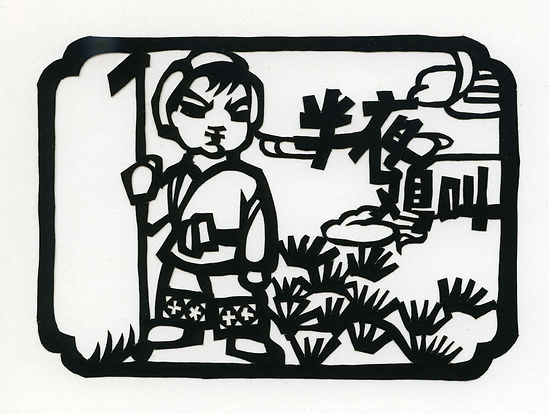
The Rooster Crows at Midnight from Gao Yubao’s autobiographical novel, published in 1955,
describes the greedy landowner Zhou Bapi, who forced his peasants to get up earlier by imitating a rooster’s crow. A peasant boy discovers the landowner’s trick and informs the other peasants.
高玉寶於1955年出版的自傳體小說《半夜雞叫》,
講述了貪婪的地主周扒皮透過模仿雞鳴,逼迫農民提前起床勞作。
農家少年高玉寶最終識破地主的詭計,並聯合其他農民將其痛打一頓。

Gao Yubao Discovers the Landowner Zhou Bapi
高玉寳智斗周扒皮
HKU.Pc.1976.2477.102
Landowner Zhou Bapi Receives Punishment
周扒皮受懲
HKU.Pc.1976.2477.105
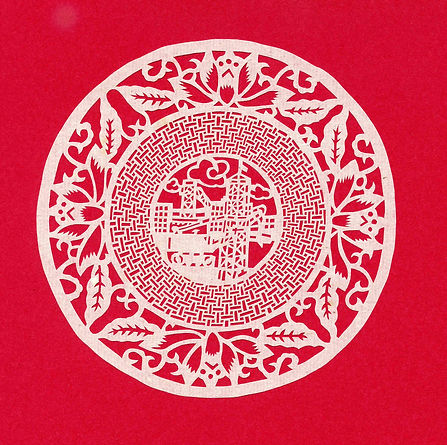
A series of round paper cuttings depicts scenes from factories and tractors in fields,
referring to the industrial modernization during the Great Leap Forward between 1958 and 1962.
採用圓形構圖,通過描繪工廠與田間拖拉機的生產圖景的系列作品,
呈現了1958至1962年大躍進期間工業現代化的時代風貌。

Chinese Modernization
中國現代化
HKU.Pc.1976.2477.353
Chinese Modernization
中國現代化
HKU.Pc.1976.2477.356
Young people with basic medical training were called barefoot doctors
and provided medical care and health services in villages during the Cultural Revolution.
文化大革命期間,接受過基礎醫療培訓的青年被稱為「赤腳醫生」,
他們在鄉村提供醫療照護與衛生服務。

Barefoot Doctor
赤腳醫生
HKU.Pc.1976.2477.311
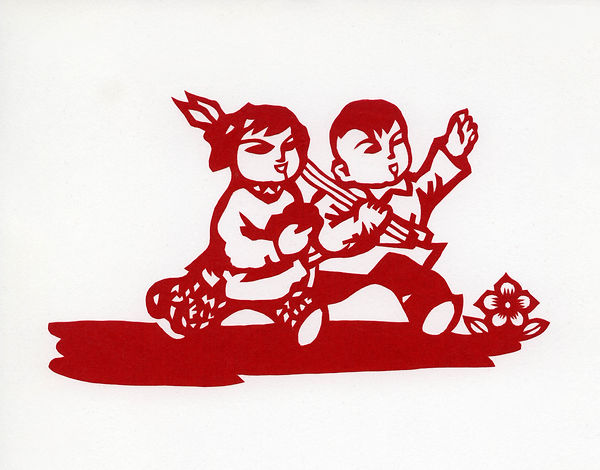
Hongxiaobing, also known as Little Red Guards or Little Red Soldiers,
was a children’s organization founded during the Cultural Revolution that existed untill 1978.
紅小兵,亦稱小紅衛兵或小紅兵,
是文化大革命期間成立的少年兒童組織。該組織於1978年解散。
Children Singing
唱歌的小孩
HKU.Pc.1976.2477.297
The Revolutionary
Opera
革命
樣板戲
09
These paper cuttings, which illustrate model operas and other art forms of the Cultural Revolution,
exemplify a revolutionary romanticism that the Chinese Communist Party sought to establish as a national identity.
這些描繪文化大革命時期樣板戲及其他藝術形式的剪纸作品,
彰顯了中國共產黨試圖確立為民族認同的革命浪漫主義。
The Red Detachment of Women is a Chinese ballet that premiered in 1964 and tells the story of a peasant girl on the island of Hainan. It has its origins in the 2nd Division of the Chinese Red Army, which consisted exclusively of women in 1931.
《紅色娘子軍》是一部於1964年首演的中國芭蕾舞劇,故事講述了海南島上一個農家女孩。其原型源於1931年成立的中國工農红軍第二獨立師中全部由女性组成的部隊。
Dancer from The Red Detachment of Women
紅色娘子軍舞者
HKU.Pc.1976.2477.632


The opera named after the city of Shajiabang is another classic. It tells the story of A Qing, a member of the Communist Party who, disguised as a teahouse owner, hides wounded soldiers led by Commissar Guo Jianguang during the Second Sino-Japanese War (1937–1945).
以沙家浜鎮命名的歌劇是另一部經典之作。故事講述共產黨員阿慶嫂在抗日戰爭期間(1937–1945年),化身茶館老闆娘,
為指導員郭建光率領的傷兵提供藏身庇護。
A Qing,
the Tea House Owner
阿慶嫂,茶館老闆
HKU.Pc.1976.2477.543
Two paper cuttings from a series of six depict the story of Bai Mao Nü, The White-Haired Girl,
a famous revolutionary opera directed by Jiang Qing (1914–1991), Mao Zedong’s wife.
A young peasant girl who was tortured by an evil landowner fled to the mountains,
where her hair turned white. Later she joined the Eighth Route Army to continue the revolution.
這兩幅來自同一套共六幅的剪紙描繪了由毛澤東之妻江青(1914–1991年)
所執導的著名革命戲曲《白毛女》故事。
這部樣板戲講述了一個年輕農家女孩遭受惡霸地主折磨,
逃入深山後頭髮變白,後來加入了八路軍投身革命的故事。


Bai Mao Nü before
Escaping to the Mountains
逃到山上前的白毛女
HKU.Pc.1976.2477.316
Bai Mao Nü after Returning
歸來後的白毛女
HKU.Pc.1976.2477.320
CHINESE PAPER CUTTINGS
AND
SWISS PAPER CUTTINGS
IN DIALOGUE
中瑞剪藝對話
Ladies, Generals &
Couples in Love
仕女,
將軍與情人
10
The set of 20 red and black paper cuttings depicting portraits of fictional and historical figures were created in 1986 by Hou Quanying from the Jieyiyuan Paper Cutting Art Center, Pingyao county town, Shanxi province. Born in Pingyao (Shanxi province) in 1949, she represents the sixth generation of a family of paper cutters.
這套共二十幅,描繪了多位虛構與歷史人物肖像的紅黑雙色剪紙,是由平遙縣花園街傑藝苑剪紙服務中心的侯全英於1986年創作。侯全英1949年出生於山西省平遙縣城,是剪紙世家的第六代傳人。


Crafts
工藝
11
Nelli Naef (b. 1935), Grape Harvest (Wimmet), 1983, 18.5 x 32.7 cm
Nelli Naef(生於1935年),《葡萄采摘時節》(Wimmet),1983年,18.5 x 32.7 厘米
Christoph Wyss (b. 1957), The Surveyor (Der Geometer), 1978, 20.8 x 30 cm
Christoph Wyss(生於1957年),《測量員》(Der Geometer),1978年,20.8 x 30 厘米
The paper cuttings by Nelli Naef and Christoph Wyss depicting craft activities were juxtaposed in dialogue form with the nearly 6-meter-long scroll entitled Bai Gong Tu.
Nelli Naef與Christoph Wyss以剪紙刻畫工藝場景之作,與近六米長的《百工圖》卷軸並置, 展現了中西方剪藝的空間對話。
The Bai Gong Tu depicts 100 different crafts on a 6-meter-long scroll. It is a comprehensive depiction of the local people’s production and daily life during the Qing dynasty, serving as a vivid portrayal of the diligent work across various trades and professions. This work is based on the Bai Gong Tu murals adorning the east and west walls of the Bai Gong She, which lies to the west of the main hall of Shuishen Tang (Hall of the Water God) in Guangling county in Shanxi province.
《百工圖》於6米長卷上描繪了100種不同工藝 。展現出清朝時期,民間百姓生產、生活的方方面面,是 各行各業辛勤勞作的真實寫照。此作取材自山西省廣靈縣水神堂正殿西側,「百工社」內的東西兩壁畫。該建築群始建於明代嘉靖年間。

100 Crafts (Bai Gong Tu)
Guangling Paper Cutting Art Museum
Shanxi province
32 x 417 cm
百工圖
中國廣靈剪紙藝術博物館
山西省
32 x 417 厘米
Zodiac & Four Seasons
生肖與四季
12
Ernst Oppliger’s (b. 1950) trees follow the principle of “as above, so below” and find their counterpart in the pair of dragons and phoenixes, which represent the principle of yin and yang. The motif of the ever-recurring cycle of the waxing and waning forces of life which we can discover in the dragon and phoenix is reflected in traditional Swiss paper cuttings depicting the ascent and descent from the Alps. The symmetry of the paper cuttings reflects, in a sense, the symmetry of life.
Ernst Oppliger’s(生於1950年)作品下的樹木,遵循「其上如此,其下亦然」的法則,並與象徵陰陽的龍鳳相互呼應。龍與鳳所展現的生命陰陽消長、往復循環的主題,亦見於描繪阿爾卑斯山牧人與牲畜上山下谷的傳統瑞士剪紙中。某種意義上說,剪紙的對稱形式,正是生命平衡之道的寫照。

Tree with Zodiac Signs
Ernst Oppliger (b. 1950)
1980
Ø 17.5 cm
星座之樹
Ernst Oppliger (生於1950年)
1980
直徑 17.5 厘米

Two Dragons
Ernst Oppliger (b. 1950)
1990
Ø 25.7 cm
雙龍
Ernst Oppliger(生於1950年)
1990年
直徑 25.7 厘米
The original scroll—25.5 centimeters in height and 5.25 meters long—was created by the Northern Song dynasty painter Zhang Zeduan, offering a meticulous depiction of the daily life and bustling scenes in the Song dynasty capital, Bianjing (present-day Kaifeng). The artwork from the Guangling Paper Cutting Art Museum, Guangling county town, Shanxi province showcased here is based on Zhao Mengfu’s version of the painting. It contains 814 people (but only 20 women), 60 animals, 30 buildings, 20 vehicles, 28 boats, 8 sedan chairs, and 170 trees.
原卷縱25.5厘米,橫5.25米,為北宋畫家張擇端所作,細膩描繪了北宋都城汴京(今開封)的繁華景象與百姓日常生活。本次展出的這件剪紙作品,產自山西省廣靈縣的中國廣靈剪紙藝術博物館,乃據趙孟頫摹本創作。全卷人物共有814人(唯女子僅20人)、動物60隻、建築30幢、車20 架、船28艘、轎8頂、樹木170棵。

Along the River During the Qingming Festival
Guangling Paper Cutting Art Museum
Shanxi province
39 x 670.20 cm
HKU.Pc.2026.2771
清明上河圖
中國廣靈剪紙藝術博物館
山西省
39 x 670.20 厘米
HKU.Pc.2026.2771
Animals
動物
13

Crane with Pine Tree
From the series ‘Pine and crane’
Yuhuan city, Zhejiang province
HKU.Pc.1976.2477.181
仙鶴與松樹
選自《松鶴》系列
浙江省,玉環市
HKU.Pc.1976.2477.181

Tiger with Bamboo
From the series ‘The Eight Great Tigers’
Yueqing city, Zhejiang province
HKU.Pc.1976.2477.815
老虎與竹
選自《八大虎》系列
浙江省,樂清市
HKU.Pc.1976.2477.815

Cat Trio
Marianne Pauschard (1945–2010)
1996
14.5 x 18.3 cm
三隻小貓
Marianne Pauschard(1945–2010年)
1996年
14.5 x 18.3 厘米

Wild Animals
Rosita Pulver (1926–2011)
1998
22 x 16 cm
野生動物
Rosita Pulver(1926–2011年)
1998年
22 x 16 厘米
Abstract & Ornament
抽象與
裝飾圖案
14
Abstract contemporary forms meet ornamentation. Here, experimental works such as Peter Germann’s (b. 1930) abstract construction can be seen alongside the waterfall made by Bendicht Friedli (b. 1930). In between are Chinese paper cuttings with floral and plant ornaments, known as ethnic motifs, which were produced in Yueqing (Zhejiang province) as well as lanterns from the Imperial Palace in Beijing.
抽象當代形式在此與裝飾元素互相交織。展品包括Peter Germann’s(生於1930年)的實驗性作品《抽象結構》,以及 Bendicht Friedli(生於1930年)的作品《瀑布》。其間穿插着產自浙江樂清,以花卉植物作裝飾的中國剪紙(被稱為「民族圖案」),以及北京故宮的宮燈。
Peter Germann, Abstract Construction II, 1996, 24.3 x 15.3 cm
Peter Germann,《抽象結構II》,1996年,24.3 x 15.3 厘米1
Bendicht Friedli, Waterfall, 1966, 58.5 x 19.6 cm
Bendicht Friedli,《瀑布》,1966年,58.5 x 19.6 厘米


Ornament
From the series ‘Ethnic Patterns’
Yueqing, Zhejiang province
裝飾圖案
選自《民族紋飾》系列
浙江省,樂清市

Lantern from the Imperial Palace
From the series ‘Palace Lanterns’
HKU.Pc.1976.2477.1161
宮廷花燈
選自《宮燈》系列
HKU.Pc.1976.2477.1161
Four Seasons
四季
15
The four noble characters created in Zhang Dong’s negative style consist of plum blossoms as a sign of endurance (winter), orchids for righteousness (spring), empty bamboo as a symbol of humility (summer), and finally chrysanthemums as a sign of purity (autumn). While four different plants characterize the four seasons, this is represented by a single tree made by Matthias Kündig containing four smaller trees that show what the tree looks like in winter, spring, summer, and autumn.
張棟以陰刻技法創作的「四君子」系列中,梅花比喻堅毅(冬)、蘭花代表正義(春)、竹表示謙遜(夏),而菊花則象徵純淨(秋),作品將四時之景,各寄於一物。而Matthias Kündig的作品則以一樹納四季——於同一大樹上衍生出四棵小樹,分別呈現冬、春、夏、秋之景。
Matthias Kündig (b. 1965), Tree with Four Seasons, 1984, 20.7 x 13 cm
Matthias Kündig (生於1965年),《四季之樹》,1984年,20.7 x 13 厘米


Plum Blossoms
(Winter/Perseverance)
Zhang Dong
From the series
‘Four Noble Ones’
2025
68 x 28.6 cm
HKU.Pc.2026.2769a
Orchid
(Spring/Integrity)
Zhang Dong
From the series
‘Four Noble Ones’
2025
68 x 28.6 cm
HKU.Pc.2026.2769b
Bamboo (Summer/Humility)
Zhang Dong
From the series
‘Four Noble Ones’
2025
68 x 28.6 cm
HKU.Pc.2026.2769c
Chrysanthemum (Autumn/Purity)
Zhang Dong
From the series
‘Four Noble Ones’
2025
68 x 28.6 cm
HKU.Pc.2026.2769d
梅(冬季/不屈)
張棟
選自「四君子」系列
2025年
68 x 28.6 厘米
HKU.Pc.2026.2769a
蘭(春季/正直)
張棟
選自「四君子」系列
2025年
68 x 28.6 厘米
HKU.Pc.2026.2769b
竹(夏季/謙遜)
張棟
選自「四君子」系列
2025年
68 x 28.6 厘米HKU.Pc.2026.2769c
菊 (秋季/高潔)
張棟
選自「四君子」系列
2025年
68 x 28.6 厘米
HKU.Pc.2026.2769d
A Bouquet of Flowers
花束
16


Address: 90 Bonham Road, Pokfulam, Hong Kong View the location on Google Maps
Tel: (852) 3917 5500 Email: museum@hku.hk
© 2026 by University Museum and Art Gallery, HKU. All Rights Reserved


