DIGITAL EXHIBITIONS2


CAPTIONS
展品簡介

Manuscript for
Le Caïd
《要塞》手稿

Antoine de Saint-Exupéry (1900–1944)
Manuscript for Le Caïd
n.p.n.d.
Single page, written on paper (front side only)
16.8 x 21.8 cm
Collection of the Saint Exupéry-d’Agay Estate
From 1936 on, Saint-Exupéry began writing a book he referred to as my “posthumous work”, which he initially titled Le Caïd and would eventually be published as Citadelle. Published in 1948, after Saint-Exupéry’s death (with two revised and expanded editions in 1958 and 1999) based on the mass of drafts and typescripts found among the writer’s papers, this monumental work of 219 chapters imparts the lessons of wisdom from a Berber chieftain (caïd) in an intensely symbolic style, full of imagery. Saint-Exupéry was attempting to address what was gradually becoming his primary concern, as expressed in several of his works in the late 1930s: the spiritual decline of humanity in a mass civilisation where standardised consumption and technology mask the loss of meaning and replace the experience of the world and of other beings.
The publication of Citadelle by Gallimard, Saint-Exupéry’s publisher, had been preceded by the publication, in the July 1948 issue of the journal La Table ronde, of an initial draft entitled “Seigneur berbère”, reprinted in the appendix from 1999 onwards under the title Le Caïd.
The draft of the beginning of this chapter is presented here:
I was a Berber chieftain and I was returning home. I had just watched the shearing of the wool from the thousand sheep that were my inheritance. In our lands, they do not wear those bells which, from the slopes of their hills, towards the stars, spread their blessings elsewhere; they simply mimic the sound of running water that never ceases to flow. And there, so close to the desert, that music alone reassures us.
So I had skimmed my gentle river, weighed my supply of white fleece, and thanked God: did He not provide, for the year, the powder for my warriors, the bread for my servants, and the jewels for my wives—for thus they are distracted from their madness; they shake their heads from right to left, which makes a sound of tinkling gold, and we know peace.
安東尼.聖修伯里(1900–1944年)
《要塞》手稿
地點及日期不詳
單頁,紙本(正面)
16.8 × 21.8 厘米
亞蓋遺產管理委員會藏
自1936年起,聖修伯里開始撰寫一部他稱為「遺作」的著作,最初命名為《首領》,死後以《要塞》之名出版。這部共219章的巨著於1948年(即聖修伯里去世後)出版,其後分別於1958年及1999年推出兩個修訂及擴充版本,內容是根據作家遺稿中大量手稿及打字稿整理而成。書中採用了充滿象徵與意象的強烈風格,講述一位柏柏爾族首領所傳授的智慧箴言。藉此,聖修伯里試圖回應一個自1930年代末期起逐漸成為他核心關注的問題:在大眾文明中,標準化的消費與科技掩蓋了意義的喪失,並取代了對世界與他人的真實體驗,從而導致人類精神上的衰退。
在伽利瑪出版社(聖修伯里的出版商)出版
《要塞》之前,《圓桌》雜誌1948年7月號已先行刊登了一份名為《柏柏爾首領》的初稿,該稿自1999年後以《首領》為題收錄於附錄中。
此處展出的,正是這一章開頭的草稿:
我是一位柏柏爾族首領,正踏上歸途。我剛剛看完了從我繼承的那上千隻羊身上剪下羊毛的過程。在我們這片土地上,人們不給羊掛上那種從山坡上傳至星辰、將祝福傳播到遠方的鈴鐺;我們只是模仿那從不間斷的流水聲。在那樣接近沙漠的地方,單是這樂聲已足以讓我們心安。
於是,我巡視了我那平緩的河流,秤過了那批白色羊毛的分量,並向主感恩:難道不是祂,為這一年為我戰士們提供了火藥、為我僕人們提供了麵包、為我妻子們提供了珠寶——因為有了珠寶,她們才得以從瘋狂中分心;她們左右搖晃著腦袋,發出叮噹作響的金屬聲,於是我們便得以享有安寧。

Two telegrams
to his mother
兩封致母親的電報


Antoine de Saint-Exupéry (1900–1944)
Two telegrams to his mother
Paris (France), 29 December 1935 and
Cairo (Egypt), 3 January 1936
Collection of the Saint Exupéry-d’Agay Estate
Having departed on 29 December 1935 from Le Bourget aerodrome (France) aboard his personal aircraft, the Caudron Simoun C630 F-ANRY, and accompanied by his mechanic, André Prévot, with the aim of breaking the speed record between Paris and Saigon (Vietnam), Saint-Exupéry crashed during the night of 29–30 December in the Libyan Desert (in Egypt). The two men had almost nothing left to drink and were hopelessly lost. After three days of walking through the desert, they were miraculously rescued by a Bedouin caravan. This episode, which Saint-Exupéry recounted in the press and on the radio, forms the central episode of Terre des hommes (Wind, Sand and Stars), published in 1939.
The two telegrams presented here were sent by Saint-Exupéry to his mother. The first just before his departure and the second after his rescue, from Cairo, where he arrived during the night of 2–3 January.
安東尼.聖修伯里(1900–1944年)
兩封致母親的電報
法國巴黎(1935年12月29日)與
埃及開羅(1936年1月3日)
亞蓋遺產管理委員會藏
1935年12月29日,聖修伯里攜同機械師安德烈.佩沃,從法國勒布爾熱機場駕駛其私人飛機—Caudron Simoun C630 F-ANRY,前往西貢(越南),旨在打破其之間的速度紀錄。然而,在12月29至30日期間,他在利比亞沙漠(埃及)墜機。兩人幾乎沒有甚麼可以飲用的東西,而且徹底迷失了方向。在沙漠中徒步三天後,他們奇蹟般地獲貝都因人營救。聖修伯里曾在報刊和廣播中講述這一經歷,而這個事件也成為了他 1939年出版的《風沙星辰》一書的核心章節。
此處呈現的兩封電報,分別是聖修伯里在出發前夕,以及在1月2至3日期間獲救並抵達開
羅後寄給母親的。

Reclining pilot
in a rocky
landscape
岩石景觀中的
斜臥飛行員

Antoine de Saint-Exupéry (1900–1944)
Reclining pilot in a rocky landscape
New York & Asharoken (USA), 1942
Drawing and watercolour on Esleeck Fidelity onionskin paper
21.5 x 27.9 cm
Collection of the Saint Exupéry-d’Agay Estate
The Little Prince contains no drawings that depict the pilot. However, the manuscript at the Morgan Library contains two watercolours showing the pilot’s hand repairing his aeroplane and holding a hammer, with the Little Prince in the background, as well as a watercolour most likely representing the pilot lying at the foot of a cliff with his aeroplane in the distance. Another version of the pilot lying down is presented here.We can thus see that Saint-Exupéry considered depicting the pilot in his story, before deciding never to show him, just as he gradually decided not to show any Earthlings, deleted numerous episodes, and stripped the narrative of all references to places.
安東尼.聖修伯里(1900–1944年)
〈岩石景觀中的斜臥飛行員〉
紐約與阿沙羅肯(美國),1942年
水彩及「Esleeck Fidelity」
洋葱紙本
21.5 × 27.9 厘米
亞蓋遺產管理委員會藏
《小王子》中並未出現描繪飛行員的畫作。然而,摩根圖書館所藏的手稿中卻包含兩幅描繪飛行員的水彩畫:一幅描繪了飛行員的手正在修理飛機、手執一把錘子,背景則是小王子;另一幅水彩畫則可能是描繪了飛行員躺臥在懸崖腳下,遠處是他的飛機。 此處展出的是另一個飛行員躺臥的版本。由此可見,聖修伯里曾考慮在故事中描繪飛行員,但最終決定從不讓他出現。正如他逐步決定不描繪任何地球人、刪除大量情節,並剔除敘事中所有提及地點的內容一樣。

The Pig’s menu
豬的菜單


Antoine de Saint-Exupéry (1900–1944)
The Pig’s menu
Algiers (Algeria), January 1944
Ink and watercolour on six sheets of cardboard
22.8 x 30.3 cm
Collection of the Saint Exupéry-d’Agay Estate
Back to North Africa in April 1943 and reintegrated into his unit, the Reconnaissance Group II/33, Saint-Exupéry was suspended by the American authorities after a landing accident with a P-38 on 1 August. While fighting to have his flying status reinstated—a battle he would finally win in April 1944—Saint-Exupéry attended a dinner in Algiers in January 1944, bringing together French and American friends. He drew the menu for the occasion and added humorous annotations alongside it; on one of the menus, he sketched a figure of the Little Prince.
1. Title page
2. The pig
Caption:
That’s the divided. / Once scattered it gives: / Berrichonne stew / Boudin accompanied by parmentier puree / Cold roast pork /Lettuce salad / Refreshed fruit / Coffee
NB 1: They forgot to tell me if there was wine and liqueurs, but I hope so. I’ve had dinner there before. (In case of an oversight, my fellow guests, this insinuation will save us.)
NB 2: On reflection, salad, fruit and coffee do not come from / the scattering of the pig.
NB 3: Neither does the parmentier puree.
3. The Little Prince on a planet, scarf blowing in the wind, sitting at a table
Speech bubble:
We don’t know everything, let’s rejoice cautiously. The menu no doubt / is wonderful... That’s the dividend / But what is the number of guests? That’s the divider.
Captions:
– before
– Here there is a total eclipse, that’s why we don’t see it
– partial eclipse
4. The shepherdess
Caption:
And that’s the shepherdess who lost her pig... A.
5. Single file (front)
Caption:
The divider goes to the table (and there may be others!)
6. Guests at the table (back)
7. End of menu – comments by the guests
安東尼.聖修伯里(1900–1944年)
〈豬的菜單〉
阿爾及爾(阿爾及利亞),1944年1月
墨水、水彩及紙板,共6頁
22.8 × 30.3 厘米
亞蓋遺產管理委員會藏
1943年4月,聖修伯里返回北非,重新編入其所屬的II/33空軍偵查小隊。同年8月1日,他在駕駛P-38閃電式戰鬥機降落時發生事故,遭美國當局勒令停飛。在極力爭取復飛(最終於1944年4月獲准)期間,聖修伯里於1944年1月在阿爾及爾出席了一場匯聚法國與美國朋友的晚宴。他為這次宴會繪製了菜單,並在旁邊加上幽默的註釋;在其中一份菜單上,他更勾勒出小王子的形象。
1. 標題頁
2. 豬
說明:
這是那隻被分切的豬。一旦分切開來,便得到:貝里式豬肉燉菜、黑血腸配馬鈴薯泥、冷烤豬肉、生菜沙律、冰鎮水果、咖啡。
註1:沒人告訴我是否備有葡萄酒與利口酒,但我希望有。我已在那兒用過晚餐。(萬一他們忘了,在座的朋友們,這句暗示能救我們。)
註2:細想之下,沙律、水果與咖啡並非源自豬的分解。
註3:馬鈴薯泥也不是。
3. 小王子坐在星球上,圍巾隨風飄揚,坐在桌子旁
對話框:
我們並非甚麼都知道,讓我們審慎樂觀地慶祝吧。無疑,菜單很精彩……那是被除數。/但客人的數目是多少?那才是除數。
說明:
– 之前
– 此處有日全食,所以我們看不見它
– 日偏食
4. 牧羊女
說明:而那位就是弄丟了她的豬的牧羊女…… A.
5. 單行隊伍(正面)
說明:「除數」就座用餐了(而且可能還有其他人!)
6. 賓客就坐(背面)
7. 菜單結尾——賓客的評價

Letter to “Loulou” (Louise de Vilmorin)
致「露露」
(露意絲.德.衛勒莫杭)


Antoine de Saint-Exupéry (1900–1944)
“One must not write fairy tales; I shall write a story about the aeroplane” [Letter to “Loulou” (Louise de Vilmorin)]
Paris (France), October 1926
Ink on cream paper
21 x 27 cm
Collection of the Saint Exupéry-d’Agay Estate
In 1920, Antoine met Louise “Loulou”, an aristocrat and future figure in French literary life. They became engaged in 1922, but the wedding, planned for December 1923, did not take place in the end, at the instigation of Louise and her family.
Despite the break-up of their engagement at the end of 1923 and Louise’s marriage in 1925, Antoine de Saint-Exupéry and Louise de Vilmorin continued to meet and correspond, keeping each other informed of their literary work—Antoine, in particular, asking Louise what she thought of his writing.
In this letter from late 1926 (following the publication of The Aviator), we see Antoine wavering between two poles of his inspiration—meditation and aviation—which he would merge in his subsequent writings. Here, he opts for the latter: “One must not write fairy tales; I shall write a tale about the aeroplane.”
Saint-Exupéry remained attached to Louise throughout his life, entrusting her with the original manuscript of his first novel, Courrier sud.
Excerpt:
If I drop by again and you have time to read me the end of your book, I’ll go to Verrières. I’m curious about it, because I like it immensely. Mine isn’t coming along at all, which is rather discouraging. The one I told you about, the one with the castle and the seven walls. The stories we love too much, we end up missing them. No matter how hard you try to find a quiet spot to be all alone, lock the door and wrap yourself up in your dream, the legend you invent loses its lustre the moment you try to bring it to life. Yet that story of the castle, the walls and the archangel would have been lovely, almost as surreal as your stories. And perhaps you would have liked it too. You know the beginning of the passage about the archangel who was so beautiful, but who never quite touched the ground because he didn’t know how to fold his wings. I’d made up an ending that seemed lovely to me. And it just isn’t coming. One must not write fairy tales; I shall write a tale about the aeroplane.
安東尼.聖修伯里(1900–1944年)
「不該寫童話;我要寫一個關於飛機的故事」 [致「露露」(露意絲.德.衛勒莫杭)]
巴黎(法國),1926年10月
墨水及米色紙本
21 × 27 厘米
亞蓋遺產管理委員會藏
1920年,安東尼結識了露意絲「露露」——一位貴族女子,日後成為法國文壇的重要人物。二人於1922年訂婚,原定在 1923年12月舉行的婚禮,最終在露意絲及其家人的阻攔下未有成事。
儘管兩人的婚約於1923年底解除,露意絲亦於1925年出嫁,聖修伯里與露意絲.德.衛勒莫杭仍持續相見與通信,彼此分享文學創作——聖修伯里尤其常請教露意絲對他作品的看法。
在1926年底的這封信中(寫於〈飛行員〉發表之後),我們看到安東尼在沉思冥想與航空飛行這兩個靈感源頭之間搖擺不定,而這兩者最終在他後來的作品中融為一體。在此信中,他選擇了後者:「不該寫童話;我要寫一個關於飛機的故事。」
聖修伯里終其一生都對露意絲懷有情誼,並將他第一部小說《南方郵航》的原稿託付給她。
信件節錄:
如果我下次經過時,而你又有時間把你書作的結尾讀給我聽,我就會去韋里耶爾。我對此很好奇,因為我非常喜歡你的作品。我的進度則完全停滯不前,這相當令人氣餒。就是我跟你提過的關於城堡與七面城牆的那個故事。那些我們太過喜愛的故事,最終反而難以寫成。無論你多麼努力尋找一個安靜的角落、獨自一人、鎖上門、將自己包裹在夢境之中,一旦你試圖將它賦予生命,你所編造的傳說便會失去光澤。然而,那個關於城堡、城牆和大天使的故事,原本可以很美——幾乎像你寫的故事一樣超現實。或許你也會喜歡它。你知道那段關於大天使的開頭,他是如此美麗,卻因不知道如何收起翅膀而從未真正踏足地面。我曾為它編了一個我覺得很美的結局。但就是寫不出來。不該寫童話故事的;我要寫一個關於飛機的故事。

Memories of Guillaumet and the Aéropostale / Tree and star-flower
〈關於紀堯梅與法國郵政航空公司的回憶〉/〈樹與星辰之花〉


Antoine de Saint-Exupéry (1900–1944)
Memories of Guillaumet and the Aéropostale / Tree and star-flower
n.p.n.d.
Ink and graphite
20.5 x 27 cm
Collection of the Saint Exupéry-d’Agay Estate
The folios of this unpublished draft relate to the famous “geography lesson” of Terre des hommes (1939), given by the pilot Henri Guillaumet to Saint-Exupéry during his first solo flight for the Aéropostale from Toulouse to Alicante in December 1926.
In the margin of the manuscript we find a theme that recurs several times in Saint-Exupéry’s drawings: the star-flower, which symbolises the link between heaven and earth.
Transcript :
Sheet 3–4 (variant on sheet 1–2):
So that evening, in 1926, Guillaumet having taught me the relief grounds, the valleys, the passes, turned around:
– At L’Hospitalet, in a north-westerly wind, if it is the storm, you will have descended perhaps three miles at sea level. It happens. You may hear the cell crack. We heard it. You will sometimes suffer head-to-tails, the Breguet 14 defends itself badly. What will you do?
I vaguely thought I would walk away from such a dirty corner.
– You will say to yourself, I may be a fool but many letters passed through L’Hospitalet when there was a north-westerly wind.
I joined the comrades at the restaurant, the friends shook my hand...
Sheet 4:
I went [home] and slept badly. I opened...
安東尼.聖修伯里(1900–1944年)
〈關於紀堯梅與法國郵政航空公司的回憶〉/〈樹與星辰之花〉
地點及日期不詳
墨水及鉛筆
20.5 × 27 厘米
亞蓋遺產管理委員會藏
此未刊手稿的頁面,關聯到《風沙星辰》(1939年)中著名的「地理課」段落——1926年12月,飛行員亨利·紀堯梅在聖修伯里為法國郵政航空公司執行首次單人飛行(自圖盧兹至阿利坎特)的途中,為他講授了這堂課。
在手稿的邊緣,我們可以發現一個反覆出現於聖修伯里畫作中的主題:象徵著天空與大地之間的連結的星辰之花。
抄錄:
第3–4頁(第1–2頁的變體):
於是那天晚上,1926年,紀堯梅教導了我辨識緊急降落地點、山谷、山口之後,轉過身來說:
「在奧斯比塔雷特,遇上西北風的時候,如果是暴風天,你可能會從三千公尺高降落到海面。這種情況是會發生的。你可能會聽見機艙裂開的聲音。我們聽見過。你有時會遭遇『頭尾對調』(逆風與尾流亂流),布雷蓋14型號飛機的應對能力並不好。你會怎麼做?」
我隱約覺得自己會有辦法逃出那個糟糕的地方。
「你會對自己說:我也許是個傻瓜,但是當西北風吹起的時候,有許許多多的郵件確實曾經穿過了奧斯比塔雷特。」
我走進餐廳與同伴們會合,朋友們與我握手……
第4頁:
我回到家,睡得很差。我打開……

“Somewhere in occupied France...” Film project centred on a character named “Gabin”
「在法國的某個佔領區……」——以名為 「加賓」的角色為核心的電影策劃


Antoine de Saint-Exupéry (1900–1944)
“Somewhere in occupied France...” Film project centred on a character named “Gabin“
New York (USA), 1942
Ink on Esleeck Fidelity onionskin paper
21.6 x 28 cm
Collection of the Saint Exupéry-d’Agay Estate
In addition to his involvement in the 1936 film adaptation of Courrier sud, Saint-Exupéry contributed to the screenplay for Anne-Marie (1935), about a woman who wishes to become a pilot. He also wrote numerous film scripts and worked on an adaptation of Terre des hommes with Jean Renoir.
The screenplay presented here was written during the Second World War. Saint-Exupéry sets the story against the backdrop of the Resistance movement in occupied Europe.
Partial transcript:
Somewhere in occupied Europe, a secret organisation is about to help four prominent figures, threatened by Nazi terror, to escape. There is a bit of everything there. The philosophy professor, the former minister, the prelate, the Jew, the factory labourer who sabotaged machinery, the lady of the manor who saved an English paratrooper, and so on. The film could begin with the ‘rescue’ of one
of them, that is to say, the moment when the person who considers himself lost is mysteriously saved.
[Example: somewhere in a prison, the interrogation by the German officer:
– So you refuse to answer?
– Yes.
– Is that your final word?
– Yes]
安東尼.聖修伯里(1900–1944年)
「在法國的某個佔領區……」——以名為「加賓」的角色為核心的電影策劃
紐約(美國),1942年
墨水及「Esleeck Fidelity」洋蔥紙本
21.6 × 28 厘米
亞蓋遺產管理委員會藏
除了參與1936年《南方郵航》的電影改編工作外,聖修伯里還曾為講述一位渴望成為飛行員的女性的作品《安妮-瑪麗》(1935年)撰寫劇本,除此之外亦創作過多部電影劇本。並曾與尚·雷諾合作,嘗試將《風沙星辰》改編為電影。
此處呈現的劇本寫於第二次世界大戰期間。聖修伯里將故事背景設定在淪陷歐洲的抵抗運動之中。
部分抄錄:
在歐洲某個被佔領的地區,一個秘密組織正準備協助四位受到納粹恐怖威脅的知名人物逃脫。那裡匯集了各式各樣的人:哲學教授、前部長、高級神職人員、猶太人、破壞機械的工廠工人、拯救過一名英國傘兵的莊園貴婦,以及其他許多人。這部電影可以從「營救」其中一人開始——也就是說,從那個自以為已無生路的人被奇蹟地拯救的那一刻展開。
「例如:某處監獄裡,德國軍官的審訊:
——所以你拒絕回答?
——是的。
——這是你最後的答覆嗎?
——是的」

“An Open Letter to Frenchmen Everywhere”
《致所有法國人的公開信》


Antoine de Saint-Exupéry (1900–1944)
“An Open Letter to Frenchmen Everywhere”
First version of the radio address of 29 November 1942
New York (USA), 1942
Autographed manuscript on Esleeck Fidelity onionskin paper with watermark
21.6 x 28 cm
Collection of the Saint Exupéry-d’Agay Estate
On 29 November 1942, following the American landing in North Africa on 8 November, which marked the start of the liberation of France, Saint-Exupéry read out “An Open Letter to Frenchmen Everywhere” on the NBC radio station, calling on French people of all persuasions, wherever they were, to unite in the fight against the common enemy.
Saint-Exupéry's statements sparked a famous controversy with the philosopher Jacques Maritain. Maritain replied to Saint-Exupéry that “it is sometimes necessary to judge” and that the Vichy authorities will be held to account, while Saint-Exupéry, insisting on the need for a common struggle against the occupying forces, rejected the spirit of partisanship and refused to contemplate future purges.
The piece presented here is a first draft of this appeal, quite different from the final text (available, like all the texts, speeches, and declarations of the period, in the Ecrits de guerre [Wartime Writings] published in 1982). In it, Saint-Exupéry places particular emphasis on the fight being waged from May–June 1940 against Nazi Germany.
Excerpt:
I speak on behalf of the one hundred and fifty thousand French soldiers and eighty thousand French civilians who were killed in three weeks in May–June 1940 during the German offensive.
(Last lines of the first page, continuing next page): I will take this story from my personal experience. I will talk about myself. But don't imagine that it's about me. I reacted, felt and acted like a hundred thousand others. Like thousands of French people perhaps. It's not a question of illustrating my part. It was, in any case, a witness to that of the two hundred and thirty thousand dead. In any case, it was less than that of the crews in my group
who perished on a war mission.
安東尼.聖修伯里(1900–1944年)
《致所有法國人的公開信》
1942年11月29日廣播稿第一版
紐約(美國),1942年
手稿原件及「Esleeck Fidelity」洋蔥紙本
21.6 × 28 厘米
亞蓋遺產管理委員會藏
1942年11月8日,美軍在北非登陸,揭開法國解放的序幕。同年11月29日,聖修伯里於NBC廣播電台宣讀一篇〈致所有法國人的公開信〉,呼籲各地、各立場的法國人團結一致,對抗共同的敵人。
聖修伯里的言論引發了他與哲學家雅克.馬里頓之間一場著名的論戰。馬里頓回應聖修伯里,指出「有時必須做出判斷」,並表示維琪政權的相關人士終將被追究責任;而聖修伯里則堅持對抗佔領軍的共同鬥爭是當務之急,拒絕黨派之爭,也拒絕設想戰後的肅清行動。
此處呈現的文件是這篇呼籲文的初稿,與最終定稿有相當大的差異(最終版本收錄於1982年出版的《戰爭筆記》,該書彙集了聖修伯里該時期的所有文章、演說與宣言)。在此初稿中,聖修伯里特別強調了1940年5月至6月對納粹德國的戰鬥。
摘錄:
我代表在1940年5月至6月德國攻勢期間、於三週內犧牲的十五萬名法國士兵與八萬名法國平民發言。(第一頁末行,接續至下一頁):我將從自己的親身經歷來講述這個故事。我會談到自己。但請不要以為這是在說我。我的反應、感受和行動,與成千上萬的其他人都一樣。也許和成千上萬的法國人沒有分別。這不是為了闡述我個人的角色。無論如何,這是對那二十三萬亡者經歷的一個見證。無論如何,這比起我大隊中那些在作戰任務中陣亡的機組人員而言,根本不值一
提。
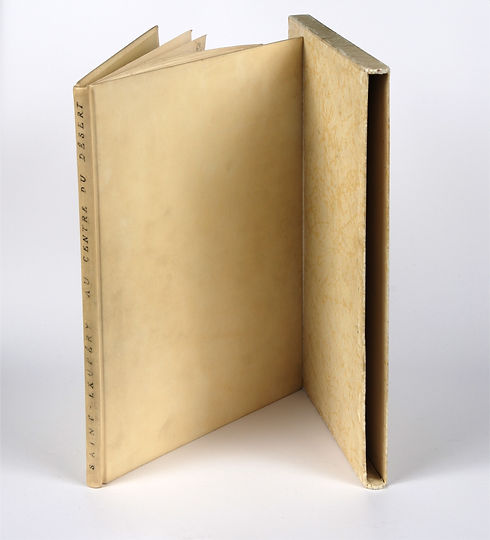
In the Heart of the Desert, manuscript for Chapter VII of Terre des hommes
[Wind, Sand and Stars]
〈沙漠的心臟〉
——《風沙星辰》第七章手稿


Antoine de Saint-Exupéry (1900–1944)
In the Heart of the Desert, manuscript for Chapter VII of Terre des hommes [Wind, Sand and Stars]
France, 1936
Hardback, 62 pp.
21 x 27.7 cm
Collection of the Saint Exup.ry-d’Agay Estate
Terre des hommes, published in 1939, brings together and weaves together several articles written by Saint Exupéry during the 1930s. Among these articles are those published in the daily newspaper L’Intransigeant from 30 January to 4 February 1936, recounting Saint-Exupéry’s odyssey in the desert from 30 December, 1935 to 2 January, 1936, which would form Chapter VII of Terre des hommes, titled “Au centre du désert”.
It is worth noting that, as was very often the case with Saint-Exupéry from the 1930s onwards, the manuscript is extremely heavily worked on, crossed out and very difficult to decipher, and that at the top of the page there is a star-shaped flower, similar to the one in the manuscript of ‘Autour de Guillaumet’.
安東尼.聖修伯里(1900–1944年)
〈沙漠的心臟〉——《風沙星辰》第七章手稿
法國,1936年
精裝本,共62頁
21 × 27.7 厘米
亞蓋遺產管理委員會藏
《風沙星辰》出版於1939年, 匯聚並編織了聖修伯里在1930年代所撰寫的多篇文章。其中包含1936年1月30日至2月4日連載於《L’Intransigeant》日報的一系列文章,記述了聖 修伯里自1935年12月30日至 1936年1月2日期間於沙漠中的歷險——這段經歷後來構成了 《風沙星辰》第七章〈沙漠的心臟〉的內容。
值得注意的是,如同聖修伯里自1930年代起一貫的創作習慣,這份手稿塗改極多、刪訂繁複,內容極難辨識。此外, 在頁面頂端可以看到一朵星辰狀的花朵,與〈關於紀堯梅〉手稿中出現的星辰之花如出一轍。

Ouvre-moi
[Open to me]
〈為我敞開〉


Antoine de Saint-Exupéry (1900–1944)
Ouvre-moi [Open to me]
Poem, seven quatrains in alexandrines, alternating rhyme Morocco and France, 1922–1924
1/ Draft, black ink on both sides of eight sheets of paper (various; among them an advertisment)
20 x 31 cm
2/ Typescript with handwritten corrections, blue ink on paper with handwritten notations in black ink, one sheet front and back
20.5 x 27 cm
Collection of the Saint Exupéry-d’Agay Estate
A number of Antoine de Saint-Exupéry’s early writings have been preserved: correspondence with his mother, occasional writings, schoolwork (he won first prize for French narrative in his class in 1914), poems, including a very short collection, L’Adieu, that he illustrated.
Almost all these texts combine writing and drawing—a pairing that would remain constant throughout Saint-Exupéry’s life. The drawings are sometimes entirely unrelated to the writing, scribbled in the margins as he wrote or added afterward, as inspiration struck. But most often they illustrate, comment on, and animate the text, which in turn responds to them. Saint-Exupéry’s decision to illustrate The Little Prince himself was thus the culmination of this lifelong dialogue between word and image, one present from his earliest years.
This can be seen in the first major body of texts Saint-Exupéry wrote with conscious literary intent: the 1921–1924 writings given to Louise de Vilmorin. Ouvre-moi, presented here, is indeed part of a collection of poems and short stories written during this period, in Morocco in 1921, and then in France. Some of them are explicitly dedicated to “Loulou”, Louise’s nickname, and the lot was given to her.
Like another longer short story, “Manon danseuse”, these texts will remain unpublished until 2018.
Although Saint-Exupéry abandoned poetry after this period, it is worth noting the intense drafting process that would characterise all his manuscripts: the drawings in the margins, the habit of writing on the letterheads of cafés and hotels, or on whatever printed paper came to hand, wherever his travels took him.
安東尼.聖修伯里(1900–1944年)
〈為我敞開〉
詩作,共七節四行詩,以亞歷山大詩體寫成,交錯押韻摩洛哥與法國,1922–1924年
1/ 草稿: 黑墨及8張正反兩面紙本(紙質多樣,其中一張為廣告紙)
20 × 31 厘米
2/ 打字稿(附手寫修改): 藍墨及紙本,附加黑墨手寫註記,正反兩面共1頁
20.5 × 27 厘米
亞蓋遺產管理委員會藏
聖修伯里早年有大量作品留存至今:與母親的通信、隨筆、學校作業(1914年曾獲班級法文敘事寫作第一名),以及詩歌——其中包括一部由他親手繪製插畫的短小詩集《告別》。
幾乎所有這些作品都結合了文字與圖畫——這種配對貫穿了聖修伯里的一生。這些圖畫有時與文字完全無關,只是他在寫作時或事後靈機一觸,隨手在頁邊空白處塗鴉而成。但在大多數情況下,它們為文字作插圖、評註,並賦予文字生命力,而文字也反過來回應圖畫。聖修伯里選擇親自為《小王子》繪製插畫,正是他從最早期便存在的「文字與圖像之間持續對話」的巔峰展現。
這一點在他第一部具有明確文學意圖的重要作品集中尤為明顯:即1921至1924年間寫給露意絲·德·衛勒莫杭的一系列文稿。此處呈現的〈為我敞開〉,便是這段時期(1921年在摩洛哥,其後在法國)所創作的詩歌與短篇小說合集的一部分。其中幾篇作品明確題獻給「露露」(露意絲的暱稱),而整批物品亦贈予了她。
與另一篇較長的短篇小說《舞者曼儂》一樣,這些作品直到2018年才得以出版。
儘管聖修伯里在此時期之後便放棄了詩歌創作,但值得注意的是,密集反覆的修改痕跡成為了他所有手稿的特色:頁邊的塗鴉、在咖啡館和酒店的信箋上寫作、或者不論身在何方皆會隨手拿起身邊任何有印刷字的紙張寫字——這些特質在
他所有手稿中始終如一。

Manuscript of the foreword to the French translation of Anne Morrow Lindbergh’s Listen! The Wind!, along with a telegram to the publisher
安.莫羅.林白
《Listen! The Wind》
法譯本序言手稿,
附致出版社電報


Antoine de Saint-Exupéry (1900–1944)
Manuscript of the foreword to the French translation of Anne Morrow Lindbergh’s Listen! The Wind!, along with a telegram to the publisher
France, summer 1939
21 x 27 cm
Collection of the Saint Exupéry-d’Agay Estate
On 10 July 1939, Saint-Exupéry agreed to write a foreword for the French translation of Anne Morrow Lindbergh’s book Listen! The Wind (Le vent se lève). He telegraphed the publisher:
“Thrilled by reading Lindbergh’s proofs. I would like to write a substantial preface rather than a short one, provided that submitting the text by July 15th does not delay your return flight to New York too much [this refers to the first non-stop New York-Biscarosse flight by a commercial seaplane carrying passengers, the Lieutenant-de-Vaisseau Paris, piloted by Henri Guillaumet]”.
Back in New York in August, Saint-Exupéry, at the invitation of Anne Morrow Lindbergh, spent the weekend of 5 and 6 August at the Lindberghs’ home, having just moved to Long Island. This meeting is recounted by Anne in her diary, War, With and Without.
This preface is one of the main texts in which Saint-Exupéry develops the principles of his literary aesthetic.
Excerpt:
I present these words to you in a jumble: courtyard, cobblestone, log, and resound. Do something with them for me... But you decline: these words lack the power to move. However, Baudelaire, if he uses this verbal material, will show you that he knows how to construct a grand image:
The wood resounding on the cobblestones of the courtyards...
[“Le bois retentissant sur le pavé des cours” in “Chant d’automne”]
With these words—courtyard, wood, or cobblestone—one strikes just as deeply at the heart as with autumns and moonlight. And I don’t see why, with diving pressures, gyroscopes, and lines of sight, the author couldn’t grab us just as effectively as with memories of love. [...] Consider the poetic image. Its value lies on a different plane than that of the words used. It does not reside in either of the two elements being associated or compared, but in the type of connection it establishes, in the particular inner attitude that such a structure imposes on us. The image is a bond that, unbeknownst to the reader, binds them.
安東尼.聖修伯里(1900–1944年)
安.莫羅.林白《Listen! The Wind》法譯本序言手稿,附致出版社電報
法國,1939年夏季
21 × 27 厘米
亞蓋遺產管理委員會藏
1939年7月10日,聖修伯里同意為安.莫羅.林白的著作《Listen! The Wind》(法譯本書名《Le vent se lève》)撰寫序言。他致電出版社:
「閱讀林白的校樣令我激動不已。我希望能寫一篇較長的序言,而非短序,前提是7月15日前交稿不至於耽誤您搭乘回紐約的航班。」(此處所指為首次使用商業水上飛機搭載乘客從紐約飛往比斯卡羅斯的航班,機型為「巴黎海軍上尉號」,由亨利.基佑美擔任機長。)
8月返回紐約後,聖修伯里應安.莫羅.林白之邀,於8月5日至6日的週末前往林白夫婦剛搬至長島的家中作客。這段會面經由安記錄於她的日記《戰爭之內與之外》中。
這篇序言是聖修伯里闡述其文學美學原則的重要文本之一。
摘錄:
我胡亂地把這些詞擺在您面前:庭院、鵝卵石、木頭、迴響。請您用它們為我做點什麼……但您拒絕了:這些詞缺乏打動人心的力量。然而,波特萊爾若用這些語言素材,便會向您證明,他懂得如何構築一個宏大的意象:
「木頭在庭院的鵝卵石上迴響……」
(出自《秋歌》:「Le bois retentissant sur le pavé des cours」)
有了這些詞——庭院、木頭或鵝卵石——如同秋天與月光一樣,同樣能深深觸動人心。而我不明白,憑藉潛水壓力、陀螺儀和瞄準線,作者為何不能像藉助愛情的回憶一樣,牢牢抓住我們的心。[……] 請想想詩意的意象。它的價值不在被關聯或比較的兩個元素身上,亦不在其中任何一者,而是在於它所建立的連結方式,在於這種結構賦予我們的內在態度。意象如同一條無形的紐帶,在讀者毫無察覺之際,已將他們牢牢繫住。
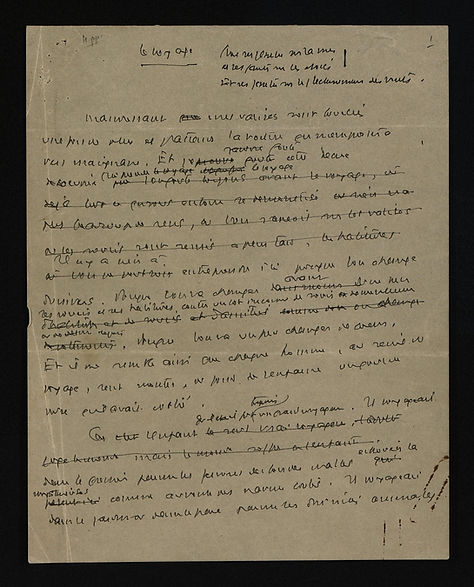
The Journey
(manuscript)
〈旅行〉
(手稿)


Antoine de Saint-Exupéry (1900–1944)
The Journey (manuscript)
n.p., 1930s (?)
Black ink on cream paper
17.5 x 22.3 cm
Collection of the Saint Exupéry-d’Agay Estate
In this text, presented here and published for the first time in 2022, Saint-Exupéry brings together two of the central themes of his thought—childhood and travel—casting the latter as a rediscovery of the child’s gaze as it awakens to the world and its marvels.
Excerpt:
Now my suitcases are packed, once again, and I am waiting for the car that will take me to Marignane. And I savor this idle hour that precedes the journey. There is nothing to do here because we are changing worlds. Because in less than an hour we will exchange our worries and habits for an unknown set of worries, wonders, and regrets. Because our hearts will change a little. And so it seems to me that every man, on the threshold of a journey, feels something rise from the depths of childhood that he had forgotten.
For the child he once was was always a great traveler. He traveled in the attic among the hardware of heavy trunks stranded there, mysterious, as one visits sunken ships. He traveled in the garden or in the park among the animal deities, the empire of ants and bees. He moved through a homeland with obscure laws, bristling with defenses, locked cupboards, forbidden doors. Everything became for him Bluebeard’s palace. Whatever he caught of conversations, allusions, [silences] in his presence—those crucial words that are riddles—everything took on a secret mourning for him, everything radiated with promises to be made. And this journey, he continued as he grew up.
A journey through the attic, then through books, then through life. First friendship, first love, first sorrow.
安東尼.聖修伯里(1900–1944年)
〈旅行〉(手稿)
地點不詳,1930年代(?)
黑墨及米色紙本
17.5 × 22.3 厘米
亞蓋遺產管理委員會藏
本篇文本於2022年首次公開發表。在此文中,聖修伯里將他思想中的兩大核心主題——童年與旅行——連結起來,把後者重新詮釋為一種對孩童目光的重新發現,一種對世界及其奇蹟的覺醒。
摘錄:
此刻,我的行李箱再次收拾完畢,正等待著那輛將載我前往馬里尼亞訥的車。我細細品味著這趟旅程前閑暇的時光。這裡無事可做,因為我們正要轉換到另一個世界。因為再不到一個小時,我們即將把原有的煩惱與習慣,交換為另一套未知的煩惱、驚奇與遺憾。因為我們的心會稍稍改變。因此在我看來,每當一個人站在旅程的門檻上,總會感受到某種從童年深處升起、早已遺忘的東西。
那個曾經的孩子,始終是一位偉大的旅行者。他從前在閣樓裡旅行,穿梭於笨重行李箱的金屬配件之間——那些箱子神祕莫測得如同人們探訪沉沒的船隻一般。他也在花園或公園裡旅行,穿梭於動物神祇、螞蟻與蜜蜂的王國之間。他在一個防備森嚴且豎立着防衛措施,上鎖的櫥櫃及禁忌之門的國度內四處游蕩。所有事物於他而言,都成了藍鬍子的城堡。不論他聽到了什麼談話、捕捉到了哪些暗示——以及他在場時所瀰漫的 [沉默]:那些至關重要的話語就像謎語一樣——一切都對他來說是一場秘密的哀悼,一切都散發著等待被兌現的承諾的氣息。而這趟旅程,他在長大之後仍然延續著。先是穿越閣樓的旅程,接著是在書本中穿梭,最後是在人生中旅行。第一段的友誼、第一段的愛情、第一段的傷痛。

Last set of proofs
for Vol de nuit
[Night Flight]
《夜間飛行》
最後校樣稿


Antoine de Saint-Exupéry (1900–1944) / Editions Gallimard
Last set of proofs for Vol de nuit [Night Flight] Paris (France), 13 May 1931
276 printed sheets with a handwritten autograph sheet dedicated to Didier Daurat
17.9 x 21.5 cm
Collection of the Saint Exupéry-d’Agay Estate
Vol de nuit, published in 1931 by Editions Gallimard, with a preface by André Gide, is Antoine de Saint-Exupéry's second novel. Written in 1929 and 1930, when Saint-Exupéry was operations manager of the Aeroposta Argentina in Buenos Aires, and completed in France, Vol de nuit combines the sensations of a pilot plunging into darkness and those of the network manager, Rivière, who is responsible for coordinating human forces in a mission that lifts individuals above themselves. Saint-Exupéry said of this book: “I’m writing a book about night flying. But in its most intimate sense, it's a book about the night.”
The set of proofs presented here is the last before publication. Saint-Exupéry added the dedication: “To Mr. Didier Daurat”. Daurat, operations manager of Lignes Latécoère, which became Aéropostale in 1927, had recruited Saint-Exupéry in 1926 and inspired
the character of Rivière.
安東尼.聖修伯里(1900–1944年)/
伽利瑪出版社
《夜間飛行》最後校樣稿
巴黎(法國),1931年5月13日
共 276 頁印刷品,附有一張獻給
迪迪埃.多拉的親筆簽名題贈頁
17.9 × 21.5 厘米
亞蓋遺產管理委員會藏
《夜間飛行》由伽利瑪出版社於1931年出版,並由安德烈.紀德作序,是安東尼.聖修伯里的第二本小說。該書創作於1929年至1930年,當時聖修伯里是阿根廷航空郵政公司駐布宜諾斯艾利斯的營運經理,最後在法國完成。《夜間飛行》融合了飛行員墜入黑暗的感受,以及網路經理希維耶的視角——他負責協調人員,完成一項超越個人極限的任務。聖修伯里曾這樣評價這本書:「我寫的是一本關於夜間飛行的書。但從最深層的意義上講,它是一本關於夜晚的書。」
此處展示的校樣是出版前的最終版本。聖修伯里在書上題寫了獻詞:「獻給迪迪埃.多拉先生」。多拉曾任拉德柯利航空公司(1927年改名為「法國郵政航空公司」)的營運經理,他於 1926年招募了聖修伯里,並成為書中角色希維耶
的靈感來源。

-
Patent no. 837.676 for a “Goniograph”
-
Patent: Technical diagram of a “Goniograph”
-
Patent (application): Route-plotting device, particularly for ships or aircraft
-
Patent: drafts
-
「測角儀」專利第837.676號
-
專利:「測角儀」技術圖解
-
專利(申請):路線測繪裝置,
特別適用於船舶或飛機 -
專利:草圖


1.
Antoine de Saint-Exupéry (1900–1944)
Patent no. 837.676 for a “Goniograph”
France, 18 November 1938
Brochure
20.9 x 26.8 cm
Collection of the Saint Exupéry-d’Agay Estate
安東尼.聖修伯里(1900–1944年)
「測角儀」專利第837.676號
法國,1938年11月18日
說明書小冊
20.9 × 26.8 厘米
亞蓋遺產管理委員會藏

2.
Antoine de Saint-Exupéry (1900–1944)
Patent: Technical diagram of a “Goniograph”
Paris (France), 1937
Printed on cardboard
20.9 x 26.8 cm
Collection of the Saint Exupéry-d’Agay Estate
安東尼.聖修伯里(1900–1944年)
專利:「測角儀」技術圖解
巴黎(法國),1937年
印刷紙板
20.9 × 26.8 厘米
亞蓋遺產管理委員會藏


3.
Antoine de Saint-Exupéry (1900–1944)
Patent: Technical diagram of a “Goniograph”
Paris (France), 1937
Printed on cardboard
20.9 x 26.8 cm
Collection of the Saint Exupéry-d’Agay Estate
安東尼.聖修伯里(1900–1944年)
專利:「測角儀」技術圖解
巴黎(法國),1937年
印刷紙板
20.9 × 26.8 厘米
亞蓋遺產管理委員會藏


4.
Antoine de Saint-Exupéry (1900–1944)
Patent: drafts
n.p.n.d.
Black ink and graphite on laid paper
20.7 x 27.2 cm
Collection of the Saint Exupéry-d’Agay Estate
安東尼.聖修伯里(1900–1944年)
專利:草圖
地點及日期不詳
黑墨、鉛筆及直紋紙本
20.7 × 27.2 厘米
亞蓋遺產管理委員會藏
Having received solid scientific training during his preparatory years at the Lycée Saint-Louis in Paris—where he was studying to sit the entrance examination for the École Navale—and drawing on his experience as an aviator, Saint-Exupéry filed a series of patents from 1934 onward to improve pilots’ equipment and flight conditions.
These patents number twelve in total: eleven filed in his own name and one anonymously, to which may be added four supplementary filings and an English version of the patent presented here, filed in 1941.
The goniograph is a navigational device designed to allow its user “to execute all geometric constructions in which a line of a given inclination with respect to any direction must be drawn through any given point.”
Also on display, a bundle of handwritten research drafts where, as usual, Saint-Exupéry draws sketches in the margins of the text.
聖修伯里在巴黎聖路易中學預科班期間接受了扎實的科學訓練——當時他正為報考海軍軍官學校的入學考試作準備——加上他作為飛行員的親身經驗,使他從1934年起陸續提交了一系列專利,旨在改善飛行員的裝備與飛行條件。
這些專利總共十二項:十一項以他本人名義提交,一項匿名提交,此外還可加上四項補充提交文件,以及此處所展出專利的一個英文版本(於1941年提交)。
測角繪圖儀(goniograph)是一種導航裝置,其設計目的是讓使用者「能夠執行所有幾何作圖,當中需要通過任意給定點,繪製一條與任意方向成特定傾斜角度的直線」。
同場展出的還有一捆手寫研究草稿,聖修伯里一如往常地在文字旁邊的空白處繪有速寫草圖
List of patents
filed by Antoine de Saint Exupéry:
795.308 – December 15, 1934: Dispositif pour atterrissage d’avions
836.790 – October 8, 1937: Nouvelle méthode pour l’atterrissage des avions sans visibilité avec dispositifs et appareils de réalisation
837.676 – October 29, 1937: Goniographe
838.687 – November 25, 1937: Système répétiteur de lecture d’appareils indicateurs ou de mesure
850.093 – August 17, 1938: Système de sustentation et de propulsion, notamment pour avions
850.098 – August 18, 1938: Appareil traceur de route, notamment pour navires ou pour avions
861.203 – July 22, 1939: Perfectionnements aux moyens de contrôle des moteurs en vol par un appareil indicateur unique
861.386 – July, 28, 1939: Nouveau dispositif de démarrage pour moteurs, spécialement pour moteurs d’avions
870.607 – June 24, 1939: Nouvelle méthode de mesure par superposition de courbes symétriques, et application aux appareils indicateurs radiogoniographique
924.902 – February 19, 1940 (with 924.903 – February 29, 1940): Nouvelle méthode de repérage par ondes électromagnétiques
864.228 – November 28 1939 (under the name of Max Ras): Torpille aérienne
安東尼.聖修伯里
申請專利列表:
795.308 – 1934年12月15日:飛機降落裝置
836.790 – 1937年10月8日:能見度為零情況下之飛機降落新方法及其實現裝置與設備
837.676 – 1937年10月29日:測角儀
838.687 – 1937年11月25日:指示或測量儀器讀數重複系統
850.093 – 1938年8月17日:升力與推進系統(特別適用於飛機)
850.098 – 1938年8月18日:路線繪測裝置(特別適用於船舶或飛機)
861.203 – 1939年7月22日:使用單一指示儀器控制飛行中引擎之改良裝置
861.386 – 1939年7月28日:引擎新型啟動裝置(特別適用於飛機引擎)
870.607 – 1939年6月24日:對稱曲線疊加測量新方法及其於無線電測向指示儀器上之應用
924.902 – 1940年2月19日(與924.903 – 1940年2月29日):電磁波定位新方法
864.228 – 1939年11月28日(以Max Ras名義申請):空中魚雷

Bernard Lamotte working on the illustrations for Pilote de guerre [Flight to Arras]
貝納德.拉莫特正在為
《航向阿拉斯》繪製插畫


Antoine de Saint-Exupéry (1900–1944)
Bernard Lamotte working on the illustrations for Pilote de guerre [Flight to Arras]
New York (USA), 1942
Brown ink on Macadamia Bond paper
20.5 x 27 cm
Collection of the Saint Exupéry-d’Agay Estate
-
Bernard Lamotte yesterday and today
-
Bernard Lamotte yesterday, today, tomorrow
Bernard Lamotte (1903–1983), artist and illustrator, was a childhood friend of Antoine de Saint-Exupéry, whom he met at the École des Beaux-Arts in Paris, where Saint-Exupéry enrolled in 1920.
Lamotte moved to New York in 1935. During his stay in America from 1941 to 1943, Saint- Exupéry was a regular visitor to Le Bocal, Lamotte’s New York studio, where Lamotte entertained numerous figures from the worlds of art and entertainment, including Ingrid Bergman, Charlie Chaplin, Salvador Dalí, and Marlene Dietrich.
It was to Bernard Lamotte that Saint-Exupéry and his publishers entrusted the task of creating the illustrations for Pilote de guerre [Flight to Arras], published in 1942.
安東尼.聖修伯里(1900–1944年)
貝納德.拉莫特正在為
《航向阿拉斯》繪製插畫
紐約(美國),1942年
棕墨及「Macadamia Bond」紙本
20.5 × 27 厘米
亞蓋遺產管理委員會藏
-
貝納德.拉莫特的昨日和今日
-
貝納德.拉莫特的昨日,今日,明日
貝納德.拉莫特(1903–1983年),藝術家與插畫家,是安東尼.聖修伯里的童年摯友。兩人相識於法國巴黎國立高等美術學院——聖修伯里於1920年進入該校就讀。
拉莫特於1935年移居紐約。在聖修伯里旅居美國期間(1941年至1943年),他時常造訪拉莫特位於紐約的工作室「Le Bocal」。拉莫特在此接待了無數藝術與娛樂界名流,包括:英格麗.褒曼、查理.卓別林、薩爾瓦多.達利,以及瑪蓮.德烈治。
聖修伯里及其出版商正是將1942年出版的《航向阿拉斯》一書之插畫創作任務,託付給
了貝納德.拉莫特。

During the writing of the story “Bark, the Moorish Slave”
撰寫〈巴克,摩爾人的奴隸〉故事期間

During the writing of the story
“Bark, the Moorish Slave”
Vintage silver print with handwritten inscription by Antoine de Saint-Exupéry (1900–1944)
11.8 x 7.7 cm
Collection of the Saint Exupéry-d’Agay Estate
In Wind, Sand and Stars, Chapter VI, Saint-Exupéry revisits a story previously published in the magazine Marianne on 17 February 1933: that of a slave, uprooted and deprived of both his freedom and his ties to others, whom Saint-Exupéry manages to redeem. Once freed, the man immediately spends his money on gifts for children, his behaviour “[having] nothing to do with the sharing of an excess of happiness. Since he was free, he possessed the essential human wealth: the right to find love, to walk to the north or the south and to earn his bread by his labours. What good was this money...... What he was experiencing, like a profound hunger, was the need to be a man among men, with ties binding him to other men.” Saint-
Exupéry here revisits one of the major themes of Terre des hommes and of his entire work: “there is only one true luxury, and that is human
relationships.”
撰寫〈巴克,摩爾人的奴隸〉
故事期間
復古銀鹽相紙,附安東尼.聖修伯里(1900–1944年)手寫題記
11.8 × 7.7 厘米
亞蓋遺產管理委員會藏
在《風沙星辰》第六章中,聖修伯里重訪了一個先前於1933年2月17日發表在《瑪麗安娜 》周報上的故事:一名遭受連根拔起、被剝奪自由與人際連結的奴隸,聖修伯里設法使他重獲尊嚴。獲得自由之後,他便立刻把錢花在送給孩子們的禮物上。他的行為「並非出於過度喜樂的分享。因為他已經自由了,他就擁有了至關重要的人類財富:擁有去尋找愛、向北或向南走去、並依靠自己的勞動賺取麵包的權利。那麼這些錢又能做什麼呢……他所體驗的,就像一種深刻的飢餓——是一種需要成為『人群中的人』的渴望,把他與他人連在一起的聯繫與紐帶。」聖修伯里在此重新觸及了《風沙星辰》乃至其全部作品中反覆探討的主要主題之一:「世間只有一種真正的奢華,那就是人與人之間的連結。」

Photographs taken during the writing of The Little Prince
《小王子》創作期間
拍攝的四張照片


Photographs taken during
the writing of The Little Prince
New York (USA), 1942–1943
Silver prints
11.5 x 7 cm / 6 x 10.5 cm /
7 x 11.5 cm / 5.9 x 10 cm
Collection of the Saint Exupéry-d’Agay Estate
Several accounts exist of the origins of The Little Prince. The most widely accepted version holds that it began in 1942, when Elisabeth Reynal, wife of the publisher Eugène Reynal, noticed Saint-Exupéry absent-mindedly sketching little figures, as he was used to, on a tablecloth during a dinner party. She suggested that he turn this character’s adventures into a story. Eugene Reynal and Curtice Hitchcock later asked him to write a story for publication at Christmas 1942.
Saint-Exupéry began writing in the late summer of 1942, at a Victorian mansion called Bevin House, in Asharoken on the North Shore of Long Island.
Since March 1942, Saint Exupéry had also been having an affair with an American journalist, Silvia Hamilton.
These four photos were taken in Silvia’s flat at 969 Park Avenue in New York. The first one shows Saint-Exupéry playing with Silvia's poodle, a likely model for the sheep in The Little Prince.
It was to Silvia Hamilton that Saint-Exupéry handed the manuscript of The Little Prince, accompanied by 35 watercolours, on the day of his departure for North Africa, 2 April 1943. The manuscript has been held in the Morgan Library in New York since 1968.
《小王子》創作期間
拍攝的四張照片
紐約(美國),1942–1943年
銀鹽相紙
11.5 x 7 厘米 / 6 x 10.5 厘米 /
7 x 11.5 厘米 / 5.9 x 10 厘米
亞蓋遺產管理委員會藏
關於《小王子》的創作緣起,流傳著多種說法。最廣為接受的版本認為,故事始於 1942 年。當時,出版商尤金.雷納爾的妻子伊麗莎白.雷納爾在一次晚宴上,留意到聖修伯里像往常一樣,心不在焉地在桌布上畫著小人的輪廓。她建議他將這個角色的冒險寫成故事。隨後,尤金.雷納爾與柯提斯.希區考克邀請他撰寫一個故事,計劃在1942年聖誕節出版。
聖修伯里於1942年夏末開始動筆,寫作地點位於長島北岸阿沙羅肯一座名為「貝文公寓」的維多利亞式宅邸。
自1942年3月起,聖修伯里亦與美國記者希薇亞.漢彌爾敦發展了一段戀情。
這四張照片拍攝於希薇亞位於紐約公園大道969號的公寓中。第一幀照片顯示聖修伯里正在逗弄希薇亞的貴賓犬——這隻狗很可能就是《小王子》中那隻綿羊的原型。
1943年4 月2 日,在聖修伯里啟程前往北非當天,他將《小王子》的手稿連同35幅水彩插畫一併交給了希薇亞.漢彌爾敦。這份手稿自1968 年起存藏於紐約摩根圖
書館。

L’aviateur,
in Le Navire d’argent
〈飛行員〉,
收錄於《銀船》雜誌

Antoine de Saint-Exupéry (1900–1944)
L’aviateur, in Le Navire d’argent
Paris (France), 1 April 1926
Paperback, 102 pp.
16.8 x 22.7 cm
Collection of the Saint Exupéry-d’Agay Estate
Antoine de Saint Exupéry arrived in Paris in 1917 to prepare for the entrance exam to the Ecole Navale at the Lycée Saint Louis. It was during this period that Saint-Exupéry began frequenting his mother's cousin, Yvonne de Lestrange's, salon. Over the years, she drew him into the world of the Nouvelle Revue Française (NRF)—the celebrated literary journal founded in 1908, closely associated with Gallimard, which became Saint-Exupéry's French publisher in 1929.
It was through Yvonne de Lestrange that Saint-Exupéry met the writers and editors Adrienne Monnier and Jean Prévot, who published his first text in 1926, in the first issue of their literary
journal Le Navire d'argent.
安東尼.聖修伯里(1900–1944年)
〈飛行員〉,收錄於《銀船》雜誌
巴黎(法國),1926年4月1日
平裝版,共102頁
16.8 × 22.7 厘米
亞蓋遺產管理委員會藏
安東尼.聖修伯里於1917年抵達巴黎,進入聖路易中學,準備海軍軍官學校的入學考試。正是在這段時期,聖修伯里開始經常造訪他母親的表親伊鳳妮.雷斯壯的沙龍。多年間,她引領他進入《新法蘭西評論》的世界——這份著名的文學期刊創辦於1908年,與伽利瑪出版社關係密切,而伽利瑪出版社自1929年起成為聖修伯里在法國的出版商。
正是透過伊鳳妮.雷斯壯, 聖修伯里結識了作家兼編輯雅德莉安.莫尼葉與Jean Prévot。1926年,後者在他們創辦的文學雜誌《銀船》的第一本期刊上,發表了聖修伯里的第一篇作品〈飛行員〉。

Newspapers
報刊文章


Newspapers
Antoine de Saint-Exupéry, “Princesses of Argentina”, Marianne, France, 14 December 1932
“A morning with Saint-Exupéry, poet of action”, Marianne, France, 14 June 1939
Collection of the Saint Exupéry-d’Agay Estate
Following the liquidation of Aéropostale in late 1931 and its integration into the new Air France company in 1933, Saint-Exupéry was no longer an airline pilot. Although he worked as a test pilot
on seaplanes for Latécoère until December 1933, when he nearly drowned in an accident, Air France did not wish to recruit him, due to the resentment of certain former colleagues, particularly regarding his success as a writer, and for having defended the president of the defunct Aéropostale, Marcel Bouilloux-Lafont.
During the 1930s, Saint-Exupéry turned to journalism: reporting (in Spain during the Civil War or in the USSR), accounts of his travels (such as here in the “Princesses of Argentina” episode, published in Gallimard’s political and literary weekly Marianne, and later included in Terre des hommes), or editorials (for Air France Revue, notably, Saint-Exupéry, having failed to be recruited as a pilot, being appointed in 1934 to the airline’s propaganda department).
“A Morning with Saint-Exupéry” is an interview with the writer at his last Parisian address, at 52 Rue Michel-Ange in the 16th arrondissement of Paris, shortly after he had received the Grand Prix de l’Académie française for Terre des hommes.
報刊文章
安東尼.聖修伯里,「阿根廷的公主們」,法國《瑪麗安娜》周報,1932年12月14日
「與行動的詩人,聖修伯里共度的早晨」,
法國《瑪麗安娜》周報,1939年6月14日
亞蓋遺產管理委員會藏
1931年底法國郵政航空公司清算解散,並於1933年併入新成立的法國航空之後,聖修伯里不再擔任航空公司飛行員。儘管他曾在拉德柯利公司擔任水上飛機試飛員直到1933年12月(期間因一次事故差點溺亡),但由於部分前同事的怨恨(尤其是對於他身為作家所獲得的成功這一點以及他曾為已倒閉的郵政航空公司總裁Marcel Bouilloux-Lafont辯護)法國航空不願聘用他。
1930年代,聖修伯里轉向新聞工作:撰寫報導(如在西班牙內戰期間或蘇聯的報導)、旅行見聞(例如這裡的「阿根廷的公主們」一文,發表於伽利瑪出版社旗下的政治文學周報《瑪麗安娜》,後來收入《風沙星辰》一書),以及撰寫社論(尤其是為《法國航空雜誌》。值得一提的是,聖修伯里在未能受聘為飛行員後,於1934年被任命到該航空公司的宣傳部門工作)。
〈與聖修伯里共度的早晨〉是一篇對這位作家的採訪,地點在他位於巴黎的最後一處住所——巴黎十六區Michel-Ange街52號,時間是在他憑藉
《風沙星辰》獲得法蘭西學院文學大獎後不久。

Pilote de guerre
[Flight to Arras],
with autograph and signed dedication to Bernard Lamotte
《航向阿拉斯》,
附有贈予貝納德.拉莫特
的題辭簽名

Antoine de Saint-Exupéry (1900–1944)
Pilote de guerre [Flight to Arras], with autograph and signed dedication to Bernard Lamotte
Original edition (French version), New York (USA),
Editions de la Maison française, 1942
Hardcover, 256 pp.
17.9 x 22.3 cm
Collection of the Saint Exupéry-d’Agay Estate
Not for sale; printed on Strathmore paper, numbered “Y”, and inscribed: Special copy printed exclusively for Mr Bernard Lamotte
Inscription to Bernard Lamotte:
For Bernard Lamotte who, as a child at Jarasse's, sucked the same milk
I did (even though he had a strong taste for Pernaud*). In memory of a wonderful time, the quays of the Seine, unfaithful girlfriends (and us!). With my deep and -faithful- friendship. Antoine de Saint Exupéry
Two arrows refer, one to the word “infidèles” [unfaithful] written above, the other to an addition: I've already written faithful above. Too bad. Enough with epithets.
*Pernaud : a French liquor, normally
spelled “Pernod”.
安東尼.聖修伯里(1900–1944年)
《航向阿拉斯》,附有贈予
貝納德.拉莫特的題辭簽名
原版,紐約(美國)
Maison française出版社,1942 年
精裝版,256 頁
17.9 × 22.3 厘米
亞蓋遺產管理委員會藏
非賣品,絲蒂摩紙本,編號 Y,
標注:貝納德拉莫特先生專用特印本
致貝納德.拉莫特的題辭:
「獻給貝納德.拉莫特,他小時候在Jarasse家喝著與我同樣的奶長大——雖說那奶裡透著一股濃烈的保樂酒味。為了懷念那段美好的時光,懷念塞納河的碼頭、那些不忠的小女友(還有我們!)。送上我深厚-而忠誠-的友誼。安東尼.聖修伯里」
文中畫了兩個箭頭:一個指向寫在上方的「不忠的」 (infidèles)一詞;另一個指向一處補充:我上面已經寫過「忠誠的」(fidéle)了。真是沒辦法。修飾詞這樣就夠了。
*保樂(Pernaud):一種法國利口酒,通常拼作 Pernod。

Le Petit Prince
[The Little Prince]
《小王子》

Antoine de Saint-Exupéry (1900–1944)
Le Petit Prince [The Little Prince]
Paris (Gallimard), France, 1946
First edition in France
Hardback with illustrated dust jacket, no. 691, 98 pp.
Collection of the Saint Exupéry-d’Agay Estate
Unable to publish the book during the war, Saint-Exupéry's French publisher Gallimard did not release it until April 1946.
Originally planned for Christmas 1945, publication was delayed by several months due to postwar paper shortages.
As the original printing plates had remained in the United States, the illustrations could not be
reproduced from them and had to be redrawn, resulting in occasional subtle differences in detail and colour. In Chapter 2, for instance, the Little Prince's cloak in “the best portrait I could manage” appears in blue rather than the original green. It was not until a new edition was issued in 1999 that the illustrations were published in their original
colours.
安東尼.聖修伯里(1900–1944年)
《小王子》
巴黎(伽利瑪出版社),法國,1946年
法國第一版
精裝版,附插圖書衣,編號691,共98 頁
亞蓋遺產管理委員會藏
由於戰爭期間無法出版此書,聖修伯里的法國出版商伽利瑪出版社直至1946年4月才將其發行。
該書原定於1945 年聖誕節面世,但因戰後紙張短缺,延遲數月後才正式出版。
由於原來的印刷版留在美國,無法以此複製插圖,因此必須重新繪製,導致細節與顏色上偶爾出現細微差異。例如在第二章中,「我所能畫出最好的畫像」裡小王子的斗篷,呈現的是藍色而非原來的綠色。直至1999年推出新版本,插圖才
以其原始色彩出版。

Lettre à un otage [Letter to a Hostage]
《給人質的一封信》

Antoine de Saint-Exupéry (1900–1944)
Lettre à un otage [Letter to a Hostage]
Original edition, New York (USA), Brentano’s, 1943 Paperback, 76 pp.
13.5 x 19.8 cm
Collection of the Saint Exupéry-d’Agay Estate
Letter to a Hostage was the last book Saint-Exupéry published in his lifetime. Its dedicatee is Léon Werth, his Jewish friend in France and the same person to whom The Little Prince is dedicated. The book opens with a melancholy evocation of Lisbon as a world in exile for the French, before recounting a lunch Saint-Exupéry once shared with Werth and two sailors on the banks of the Saône—a passage full of vitality and a warm tribute to human fellowship. The book also looks back on his experience as a reporter during the Spanish Civil War.
安東尼.聖修伯里(1900–1944年)
《給人質的一封信》
初版,紐約(美國),布倫塔諾出版社,1943年
平裝版,76 頁
13.5 × 19.8 厘米
亞蓋遺產管理委員會藏
《給人質的一封信》是聖修伯里生前出版的最後一本書,此書題獻給雷昂.魏爾特——他在法國的一位猶太朋友,同時也是《小王子》的題獻對象。該書開篇以憂傷的筆觸將里斯本描繪為法國人流亡的世界。隨後記述了聖修伯里與魏爾特及兩名水手在索恩河畔共進午餐的情景。這一段敘述充滿生機,是對人類友誼的溫暖禮讚。聖修伯里還在書中回顧了他在西班牙內戰期間擔任記者
的經歷。

Letter to his mother
(Mauve ink on cream paper)
致母親的信
(紫褐色墨及米色紙本)

Antoine de Saint-Exupéry (1900–1944)
Letter to his mother
Strasbourg (France), 1921 Mauve ink on cream paper
27 x 16 cm (facsimile)
Archives nationales, Paris (France)
The correspondence between Antoine de Saint-Exupéry and his mother Marie, comprising 182 letters published between 1910 and 1944, is a major part of the writer’s oeuvre.
The letter on display dates from Antoine de Saint-Exupéry’s military service, when he was first posted to Strasbourg. Saint-Exupéry describes the steps he had taken to obtain a civilian pilot's licence. Although he did not yet know how to fly, he was allowed to board aircraft in flight. Combining text and drawing, as he almost always does in his manuscripts, Saint-Exupéry gives his mother a “soberly artistic picture [that] represents the aerial combat of tomorrow”. A few lines earlier, he describes his feelings at altitude and the aircraft in his regiment:
I got out of a Spad-Herbemont, completely turned round. My notions of space, distance and direction had been thrown off balance up there. When I was looking for the ground, sometimes I was looking below me, sometimes above, to the right, to the left. I thought I was very high up and then suddenly I was brought down to the ground by a vertical spin. I thought I was very low and I was sucked down to a thousand metres in two minutes by the 500 horsepower of the engine. It was dancing, pitching, rolling... Oh la la!
(...) the Hanriots, the pot-bellied bolides, and the Spads-Herbemont, the current kings, compared to which no plane exists, looking mean with their wing profile like a furrowed brow. You have no idea how evil and cruel a Spad-Herbemont looks. It's a terrible plane. That's what I would love about flying it. It hangs in the air like a shark in water, and it looks just like a shark! Same weirdly smooth body. The same smooth, fast movement. It still holds the
air, vertical on the wings.
安東尼.聖修伯里(1900–1944年)
致母親的信
史特拉斯堡(法國),1921年
紫褐色墨及米色紙本
27 × 16 厘米(複製品)
國家檔案室藏,巴黎(法國)
安東尼.聖修伯里與母親瑪麗之間的通信,共收錄182封寫於1910年至1944年間的信件,是這位作家作品中非常重要的一部分。
本次展出的這封信寫於聖修伯里服兵役期間,當時他首次被派駐至史特拉斯堡。聖修伯里在信中描述了他為取得民用飛行員執照所採取的各項步驟。儘管他還不會飛行,卻已被允許登上飛行中的飛機。一如他幾乎總在手稿中結合文字與繪圖的風格,聖修伯里為母親描繪了一幅「樸素而具藝術感的圖畫,代表了明日的空中戰鬥」。在此前幾行,他描述了自己在空中的感受,以及他所在部隊中的飛機:
「我從一架斯派德戰機上下來,整個人頭暈目眩。我對空間、距離和方向的感知在高空中完全失調。當我要尋找地面時,我時而往下看,時而向上看、往右看、往左看。我以為自己飛得很高,卻突然被一個垂直旋轉帶著衝向了地面;我以為自己飛得很低,卻被引擎的五百匹馬力在兩分鐘內拉到一千公尺之高。飛機又顛簸、又搖晃、又翻滾……天啊!
(……) 昂里奧飛機 —— 那些飽滿卻威力十足的“力量型”機種,還有斯派德戰機——他們可說是飛機中的王者,在它們身邊的其他飛機都黯然失色。它們的機翼輪廓如同緊綳的眉峰。你無法想像一架斯派德戰機看起來有多邪惡、多殘酷。那是一架可怕的飛機,但正因如此,我才會愛上駕駛它。它懸浮於空氣中,就像鯊魚在水中游動,而且它的外形也很像鯊魚!同樣圓潤光滑的身軀,同樣流暢迅猛的動作。它依然牢牢抓住空氣,機翼垂直地懸
停著。」

Letter to his mother
(Green ink on lined paper)
致母親的信
(綠墨及橫格紙本)

Antoine de Saint-Exupéry (1900–1944)
Letter to his mother Casablanca (Morocco), 1921 Green ink on lined paper
13.3 x 20.8 cm (facsimile)
Archives nationales, Paris (France)
In this letter, written by Saint-Exupéry during his military service in Morocco, Antoine recounts his training flights and, as is almost always the case in his manuscripts, combines text and drawing. Here, on page 4, he sketches himself as an aviator,
“weighing as much as a pachyderm (...) I have a balaclava that only opens over my eyes — like a balaclava — and even then, over said eyes, I have glasses... A large scarf around my neck (my uncle's scarf), your white jersey and over it all a warm jumpsuit. Huge gloves, and two pairs of socks in my large shoes.”
安東尼.聖修伯里(1900–1944年)
致母親的信
卡薩布蘭卡(摩洛哥),1921年綠墨及橫格紙本
13.3 x 20.8 厘米(複製品)
國家檔案室藏,巴黎(法國)
這封聖修伯里在摩洛哥服兵役期間寫給母親的信中,安東尼講述了他的飛行訓練課程,並且一如他在手稿中經常展現的那樣, 將文字與繪畫結合在一起。在第4頁上,他為自己畫了一幅飛行員速寫:
「 重得像一頭厚皮動物(……)我戴了一頂只露出眼睛的極地防風雪帽——像巴拉克拉瓦帽——而且,就算露出『所謂的眼睛』,我還戴了眼鏡……脖子上圍著一條大圍巾(舅舅的圍巾),穿著您給我的白色針織衫,最外面再套上一件保暖連身服。手上戴著巨大的手套,寬大的鞋子裡還套了兩雙襪子。」

The Little Prince
sitting on the edge
of a cliff
小王子坐於懸崖邊

Antoine de Saint-Exupéry (1900–1944)
The Little Prince sitting on the edge of a cliff
New York (USA), 1942
Sepia ink on Esleeck Fidelity onionskin paper
21.5 x 27.9 cm (facsimile)
Original held at the Morgan Library, Joseph Cornell collection [New York (USA)]
Saint-Exupéry frequently gave away his drawings, or created them specifically for his friends. This is the case with the manuscript of The Little Prince held at the Morgan Library in New York, which Saint-Exupéry gave to his friend Silvia Hamilton; but it is also true of a great many drawings or series of drawings, such as two given to the American artist Joseph Cornell, also held by the Morgan Library.
One will note in the drawing a wide range of iconographic themes that appear frequently in Saint-Exupéry’s drawings from 1939 on, and which, along with the stars, generally accompany the Little Prince, either in whole or in part: a winding road, a hill, a cliff, flowers with petals, and a radiant sun.
安東尼.聖修伯里(1900–1944年)
小王子坐於懸崖邊
紐約(美國),1942年
棕黑色墨及「Esleeck Fidelity」洋蔥紙本
21.5 × 27.9 厘米(複製品)
原件藏於摩根圖書館,約瑟夫.康奈爾收藏
[紐約(美國)]
聖修伯里經常將自己的畫作送贈他人,或特意為朋友而創作。《小王子》的手稿(現藏於紐約摩根圖書館)是他送給友人希薇亞·漢彌爾敦的禮物;除此之外,還有大量畫作或系列畫作亦屬此類,例如送贈予美國藝術家約瑟夫.康奈爾的兩幅作品(同樣藏於摩根圖書館)。
從這幅畫作中,可以看到一系列自1939年以來經常出現在聖修伯里作品中的圖像元素。這些元素與星星一起,無論是全體或局部,通常都伴隨着小王子出現:蜿蜒的小路、山丘、懸崖、帶花瓣的花朵,以及一輪燦爛的太陽。

War Cross
1939–1945
with palms
1939–1945年
飾有棕櫚葉紋的
戰爭十字勳章

War Cross 1939–1945 with palms
Bronze cross with a red and green striped ribbon adorned with three palms, 4.5 x 11 cm
Collection of the Saint Exupéry-d’Agay Estate
This War Cross with three palms was awarded posthumously to Antoine de Saint-Exupéry by the French Air Force at the French École Militaire, on 28 September 2024, marking the 80th anniversary of his disappearance while on a wartime mission, in recognition of the three commendations that he received:
– 22 May 1940
DE SAINT-EXUPERY (Antoine-Jean-Baptiste-Marie-Roger), Captain: a pilot officer possessing the finest intellectual and moral qualities, who constantly volunteered for the most perilous missions. He successfully completed two photographic reconnaissance missions with distinction. On 22 May 1940, coming under heavy fire from intense and powerful anti-aircraft defences, he only abandoned his mission when his aircraft had been seriously damaged. He is a model of duty and self-sacrifice to the unit’s personnel.
– 3 November 1944
General de Gaulle, President of the Provisional Government of the French Republic and Commander-in-Chief of the Armed Forces, awards:
BY ORDER OF THE AIR FORCE
to Antoine de Saint-Exupéry,
Commander of the 31st Air Wing
A highly skilled reconnaissance pilot, consistently demonstrating the finest qualities of daring and skill. During June and July 1944, he carried out, over France in an unarmed single-seater, a superb series of long-range photographic reconnaissance missions. In particular, on 23 June, he carried out an excellent aerial reconnaissance mission over France, at the end of which he was intercepted by two enemy fighters. He managed to escape by manoeuvring and to return with the intelligence gathered.
On 29 June 1944, having been forced to shut down one engine due to mechanical trouble during a mapping mission, he managed to return his aircraft and the intelligence gathered after flying over more than 250 kilometres of enemy territory and 200 kilometres of sea.
This citation entails the award of the Croix de Guerre with palm.
Paris, 3 November 1944
Signed: de GAULLE
– 8 March 1950
THE MINISTER OF NATIONAL DEFENCE,
awards the Order of:
— THE AIR FORCE, posthumously, to
Captain Antoine DE Saint-Exupéry of Reconnaissance Group No. II/33.
A pioneer of aviation, through his unfailing tenacity and thoughtful daring, he has brought new glory to the French Air Force.
An ardent fighter pilot, he demonstrated in 1940 and 1943 his passion for service and his faith in the destiny of the Fatherland.
He expressed his taste for action and the generosity of his ideals in a literary work that ranks among the most important of our time and which celebrates the spiritual mission of FRANCE.
He met a glorious death on 31 July 1944 whilst returning from a long-range reconnaissance mission over his country, which was occupied by the enemy.
THIS CITATION CONSTITUTES THE AWARD OF THE 1939–1945 WAR CROSS WITH PALM.
PARIS, 8 March 1950
1939–1945年飾有棕櫚葉紋的戰爭十字勳章
青銅十字章,配紅綠條紋絲帶,綴有三片棕櫚葉,4.5 × 11 厘米
亞蓋遺產管理委員會藏
這枚飾有三片棕櫚葉紋的戰爭十字勳章,是由法國空軍於2024年9月 28日在法國軍官學校追授予安東尼·聖修伯里,以紀念他在戰時任務中失蹤80週年,並表彰他所獲得的三項嘉獎:
1940年5月22日
德·聖修伯里(Antoine-Jean-Baptiste-Marie-Roger),上尉:一位具備最優秀智識與道德品質的飛行軍官,不斷自願執行最危險的任務。他出色地完成了兩次照相偵察任務。於1940年5月22日,在遭遇猛烈而強大的防空火力攻擊後,他直到飛機嚴重受損才放棄任務。他是部隊中盡職與自我犧牲的典範。
1944年11月3日
戴高樂將軍,法蘭西共和國臨時政府主席兼三軍總司令,頒令:
根據空軍命令
授予第31航空聯隊指揮官
安東尼·聖修伯里
一位技藝高超的偵察飛行員,始終展現出卓越的膽識與技能。1944年6月至7月期間,他駕駛無武裝的單座飛機,在法國上空完成了一系列出色的遠程照相偵察任務。特別是在6月23日,他在法國上空執行了一次卓越的空中偵察任務,任務結束時遭到兩架敵方戰鬥機攔截。他通過機動動作成功脫身,並帶回所獲情報。
1944年6月29日,在一次測繪任務中,由於機械故障被迫關閉一台發動機後,他設法在飛越超過250公里敵佔區和200公里海域後,將飛機及所獲情報帶回。
此項嘉獎授予飾棕櫚葉的戰爭十字勳章。
巴黎,1944年11月3日
簽署:戴高樂
1950年3月8日
國防部長,追授以下勳章:
空軍勳章
授予第II/33空中偵查小隊上尉安東尼·聖修伯里
航空事業的先驅,憑藉其堅韌不拔的毅力和深思熟慮的勇敢,為法國空軍帶來了新的榮耀。
作為一位熱忱的戰鬥機飛行員,他在1940年和1943年展現了對職責的熱誠以及對祖國命運的信念。
他將對行動的熱愛和理想的慷慨融入文學作品之中,其作品位居我們這個時代最重要的文學之列,並頌揚了法蘭西的精神使命。
他於1944年7月31日在對被敵人佔領的祖國執行遠程偵察任務歸途中光榮犧牲。
此嘉獎構成授予1939–1945年戰爭十字勳章(飾棕櫚葉)。
巴黎,1950年3月8日

Assessment of
Captain Saint-Exupéry
by his superior,
Major Alias
聖修伯里上尉的上級
Alias少校
對其的考評

Assessment of Captain Saint-Exupéry by
his superior, Major Alias
Tunis (Tunisia), 1940
Facsimile, original in the Service historique de la
Défense, Vincennes (France)
Mobilised in September 1939 following France's declaration of war on Nazi Germany, Saint- Exupéry was initially confined to the role of instructor. However, he insisted on being assigned to a combat unit. In a letter dated 26 October 1939, he wrote: “I have a lot to say about events. I can say them as a combatant and not as a tourist. This is my only chance to speak out”.
Assigned to the Air Reconnaissance Group II/33, he carried out several reconnaissance missions before and during the German invasion of France, including the mission over Arras on 23 May, which was the focus of his memoir Pilote de guerre.
After the armistice of June 1940, with his group retreated to North Africa, Saint-Exupéry's superior wrote in his file:
A most accomplished and resilient pilot, whose reputation speaks for itself. Highly experienced, he is constantly offering advice to younger pilots—advice that is invariably heeded—which makes him invaluable. (...)
Asked on several occasions to carry out a mission abroad (USA) or to occupy a post for the CNRS (Centre national de la Recherche scientifique), he refused with the greatest energy, wanting, in his own words, “to take
his share of risk and danger”.
聖修伯里上尉的上級
Alias少校對其的考評
突尼斯,1940年
複製品,原件藏於法國萬塞訥國防
歷史服務部
1939年9月法國對納粹德國宣戰後,聖修伯里被動員入伍,最初只被安排擔任教官。但他堅持要求分配到作戰部隊。在1939年10月 26日的一封信中,他寫道:「關於當前的局勢,我有許多話要說。我必須以戰鬥員而非遊客的身份來說這些話。這是我開口發聲的唯一機會。」
他被分配到第II/33空中偵察小隊,在德國入侵法國之前及期間執行了多次偵察任務,其中包括5月23日飛越阿拉斯上空的任務,那次任務正是《航向阿拉斯》一書的核心內容。
1940年6月停戰協定簽訂後,小隊撤至北非。聖修伯里的上級在他的檔案中寫道:
「一位極為出色且堅韌不拔的飛行員,其聲譽有目共睹。他經驗極其豐富,不斷向年輕飛行員提供建議——這些建議總是受到重視——這使他成為不可或缺的人物。(……)
曾多次被邀請前往國外(美國)執行任務或在法國國家科學研究中心任職,但他都以最大的熱忱拒絕了,用他自己的話說,他想要
『分擔風險與危險』。」

Two Little Princes
《兩位小王子》

Antoine de Saint-Exupéry (1900–1944)
Two Little Princes
Algiers (Algeria), 1944
Personal diary “British Airways 1943”,
dark blue leather binding, black ink on blue paper
10.5 x 7 cm (facsimile)
Collection of the Saint-Exupéry-d’Agay Estate
This 1943 personal diary, produced by British Airways, has a blue leather cover and contains an address book, notes, appointments, and drawings—among them three figures of the Little Prince, appearing on the cover page and the first double-page spread.
Saint-Exupéry used it during the first half of 1944 while in North Africa.
Correcting the dates printed for 1943 by hand, he thus writes down two appointments in March 1944: with the writer André Gide on Thursday the 16th and with the actor Jean Gabin on
Friday the 17th.
安東尼.聖修伯里(1900–1944年)
《兩位小王子》
阿爾及爾(阿爾及利亞),1944年
「英國航空 1943」私人日記,
深藍色皮革裝訂,黑墨及藍色紙本
10.5 × 7 厘米(複製品)
亞蓋遺產管理委員會藏
這本1943 年的私人日記由英國航空出品,藍色皮革封面,內含通訊錄、筆記、約會記錄及繪畫——其中三個小王子的形象,分別出現在封面頁及首個雙頁跨版上。
聖修伯里於1944年上半年在北非使用這本日記。他手動更正了日記上印刷的1943年日期,並記錄了1944年3月的兩次約會。分別是3月16日週四與作家安德烈.紀德會面,以及3月17日週五與
演員尚.加賓會面。

-
The Little Prince on his planet overrun by a baobab tree
-
The Little Prince lying amongst flowers at the foot of a tree
-
The Little Prince flying over a planet with a mountain and a river
-
小王子在其星球上,
被猴麵包樹覆蓋 -
小王子躺臥於樹下的花叢中
-
小王子飛越一座
有山河相伴的星球


Antoine de Saint-Exupéry (1900–1944)
The Little Prince on his planet overrun by a baobab tree
The Little Prince lying amongst flowers at the foot of a tree
The Little Prince flying over a planet with a mountain and a river
New York / Asharoken (USA), 1942
Watercolour, ink and pencil on Esleeck Fidelity onionskin paper (facsimiles)
Originals in the Morgan Library [New York (USA)]
On the day of his departure from the United States for North Africa, to resume service in the fight against Nazi Germany, Saint-Exupéry gave the manuscript of The Little Prince as a gift to Silvia Hamilton, an American journalist with whom he was having an affair.
This manuscript, acquired by the Morgan Library in 1968, represents a version of the text that is not the final one. It consists of 141 handwritten pages, several of which contain drawings, as well as 35 watercolours. These watercolours, as can be seen from the pieces on display, differ significantly from those that were ultimately selected; indeed, as in the case of the third, they refer to episodes that were later omitted.
安東尼.聖修伯里(1900–1944年)
小王子在其星球上,被猴麵包樹覆蓋
小王子躺臥於樹下的花叢中
小王子飛越一座有山河相伴的星球
紐約/阿沙羅肯(美國)
水彩、墨水、鉛筆及「Esleeck Fidelity」
洋蔥紙本(複製品)
原件藏於摩根圖書館 [紐約(美國)]
在聖修伯里離開美國前往北非,準備重返抗擊納粹德國的戰場當天,他將《小王子》的手稿送給了當時正與他有一段戀情的美國記者希薇亞.漢彌爾敦。
這份手稿於1968 年由摩根圖書館購藏, 其文字並非《小王子》的最終版本。手稿共包含141頁手寫稿紙,其中數頁附有畫作,以及35幅水彩畫。從展出的作品可以看出,這些水彩畫與最終選定的版本有顯著差異;事實上,正如第三幅水彩畫所示,它所描繪的情節後來被刪除了。

To an Unknown Woman
致一位不知名的女士

Antoine de Saint-Exupéry (1900–1944)
« Pardon de vous déranger… c’était seulement pour dire bonjour ! »
[“Sorry to disturb you... I just wanted to
say hello!”]
To an Unknown Woman [Algiers (Algeria), 1943 or 1944]
Ink and watercolour on Esleeck Fidelity onionskin paper
21.6 x 28 cm (facsimile)
Private collection
In May 1943, Saint-Exupéry, who had returned to North Africa in April, met a woman officer, a Red Cross ambulance driver, on a train from Oran to Algiers. He fell in love with her and wrote her several bittersweet, melancholy and dream-like letters, in which he made the Little Prince his spokesman.
The set, revealed to the public at a public auction in 2007 and then published in 2008, comprises nine letters on twelve sheets, eight of which are illustrated. As well as providing an important record of the last year of Saint-Exupéry's life, it is also the primary set of Little Princes the author painted after the book’s publication in April 1943.
Facsimile of page 2 is presented here.
安東尼.聖修伯里(1900–1944年)
「抱歉打擾您……我只是想說聲你好!」
致一位不知名的女士 [阿爾及爾(阿爾及利亞),1943年或1944年]
墨水、水彩及「Esleeck Fidelity」洋蔥紙本,21.6 × 28 厘米(複製品)
私人收藏
1943年5月,四月份剛回到北非的聖修伯里,在一列從奧蘭開往阿爾及爾的火車上遇到了一位女軍官兼紅十字會的救護車駕駛員。他愛上了她,並為她寫了幾封苦樂參半、憂鬱而又如夢似幻的信件,在信中他讓小王子成為自己的代言人。
這批信件於2007年的一次公開拍賣中問世,隨後在2008年出版,共包含九封信(寫在十二張紙上),其中八封配有插畫。這批信件不僅為聖修伯里生命最後一年提供了重要記錄,也是作者在
《小王子》於1943年4月出版之後所繪製的最主要的一組小王子畫作。
此處展出的是第2頁的複製品。

-
Drawing of the Little Prince
given to Hedda Sterne -
Letter to Hedda Sterne
with a drawing of the Little Prince -
Note to Hedda Sterne
with a drawing of the Little Prince
-
《小王子》
——贈予海達.斯特恩的畫作 -
致海達.斯特恩的信函,
附一幅小王子畫作 -
給海達.斯特恩的便條,
附一幅小王子畫作


Antoine de Saint-Exupéry (1900–1944)
Drawing of the Little Prince given to Hedda Sterne
Letter to Hedda Sterne with a drawing of the Little Prince
Note to Hedda Sterne with a drawing of the Little Prince
New York (USA), 1942–1943
Ink on white paper (facsimiles)
Originals in the Smithsonian Institution, Hedda Sterne collection [Washington D.C. (USA)]
Hedda Sterne (1910–2011) was a Romanian Jewish artist who emigrated to the United States in 1941. Saint-Exupéry spent time with her during his stay in the United States. Upon his departure in April 1943, Saint-Exupéry left her the manuscript of Letter to a Hostage.
Letter:
Quite right. I waited (by the telephone) all afternoon for your return home. I am very sorry to have missed you. I wanted to thank you for everything, for the spiritual support you give to the Caid. If I knew how to write letters, I would write you a long one, but I’ve been an idiot for four or five years now and don’t really know how to communicate properly anymore. I hate myself.
You’ve helped me more than you realise.
Thank you.
Your friend
Antoine
Letter:
I’ve only just arrived
Are you free for dinner? Give me a ring.
Thank you.
A.
P.S.: A setback delayed this letter, so it hasn’t been sent yet, but — to be perfectly honest — I’m so proud of my
masterpiece that I’m sending it to you anyway.
安東尼.聖修伯里(1900–1944年)
《小王子》——贈予海達.斯特恩的畫作
致海達.斯特恩的信函,附一幅小王子畫作
給海達.斯特恩的便條,附一幅小王子畫作
紐約(美國),1942–1943 年
紙本墨水(複製品)
原件藏於史密森學會海達.斯特恩藏品庫
[華盛頓(美國)]
海達.斯特恩(1910–2011年)是一位羅馬尼亞猶太裔藝術家,1941年移居美國。聖修伯里在美國期間與她常有往來。1943年4月他離開美國時,將《給人質的一封信》的手稿留給了她。
信函內容:
的確如此。我整個下午都在(電話旁)等你回家。很遺憾沒能見到你。我想感謝你為我做的一切,感謝你對《首領》一書所提供的的精神支持。如果我擅長寫信,我會給你寫一封長信,但這四五年來我一直像個傻瓜,已經不太懂得如何好好與人溝通了。我厭惡自己。
你對我的幫助超乎你所想。
謝謝你。
你的朋友
安東尼
便條內容:
我剛到。
你晚上有空一起吃飯嗎?我會等你電話。
謝謝。
A.
附註:因為一個小意外,這張便條遲遲未寄出,所以一直沒能發出去——但老實說,我對自己的這幅傑作感到驕傲,所以還是決定
把它寄給你。

Pilote de guerre
(Flight to Arras)
《航向阿拉斯》

Antoine de Saint-Exupéry (1900–1944)
Pilote de guerre (Flight to Arras)
Paris (France), Gallimard, 1942, authorization number: 14.327
Paperback, 248 pp.
12 x 18.7 cm
Collection of the Saint Exupéry–d’Agay Estate
Published in February 1942 in the United States, in French and English, and then in France in November 1942, Pilote de guerre is a striking depiction of Saint-Exupéry’s mission over Arras on May 23, 1940, as well as the French rout. Written to persuade the United States that the French had fought courageously against the Germans, the book was initially intended to convince them to enter the war, but was not published until after Pearl Harbor.
This volume, published in Occupied France, bears a censorship approval number. In February 1943, the book was banned by the German authorities, but still published
clandestinely.
安東尼.聖修伯里(1900–1944年)
《航向阿拉斯》
巴黎(法國),伽利瑪出版社,
1942年,授權編號:14.327
平裝版,248頁
12 × 18.7 厘米
亞蓋遺產管理委員會藏
《航向阿拉斯》於1942年2月在美國以法文及英文出版,同年11月在法國出版。該書生動描繪了聖修伯里於1940年5月23日在阿拉斯上空執行的任務,以及法軍的潰敗。此書旨在說服美國人相信法國人曾英勇抵抗德軍,起初希望促使美國參戰,但最終在珍珠港事件後才得以出版。
此版本在法國淪陷區出版, 印有審查批准編號。1943年2月,該書被德國當局禁止售賣,但仍以地下形式秘密出版。

-
Saint-Maurice-de-Rémens postcard
-
The five Saint-Exupéry siblings and their mother at Saint-Maurice-de-Rémens
-
Gabrielle, François, and Antoine in the park at Saint Maurice-de-Rémens
-
The library
-
The living room
-
聖莫里斯德雷芒城堡明信片
-
聖修伯里五兄弟姊妹與他們的母親
在聖莫里斯德雷芒城堡 -
加百列、馮斯華與安東尼
在聖莫里斯德雷芒的公園裡 -
圖書館
-
客廳


Saint-Maurice-de-Rémens postcard
France
ca. 1900
The five Saint-Exupéry
siblings and their mother at
Saint-Maurice-de-Rémens
ca. 1905
Gabrielle, François, and
Antoine in the park at Saint
Maurice-de-Rémens
ca. 1910
The library
n. d.
The living room
n. d.
Located in Saint-Maurice-de-
Rémens, 50 km northeast of Lyon, Château de Saint-Maurice-de-Rémens and its park played an important role in Saint-Exupéry’s life and work. The château belonged to the Countess de Tricaud, who, upon her death in 1920, bequeathed it to her grandniece, Marie de Saint-Exupéry, the writer’s mother. It was here that the family gathered regularly during the holidays following Saint-Exupéry’s father’s death in 1904, and nearby, at the Ambérieu airfield, where Saint-Exupéry made his first flight in 1912. Facing financial difficulties, Marie de Saint-Exupéry sold the château to the city of Lyon in 1932. For Antoine de Saint-Exupéry, the château and the surrounding park were the magical world of his childhood. In several letters and parts of his works, Saint-Exupéry recalls the château.
聖莫里斯德雷芒城堡明信片
(法國)
約1900年
聖修伯里五兄弟姊妹與他們的
母親在聖莫里斯德雷芒城堡
約1905年
加百列、馮斯華與安東尼在聖
莫里斯德雷芒的公園裡
約1910年
圖書館
年份不詳
客廳
年份不詳
聖莫里斯德雷芒城堡位於里昂東北50公里處,其公園在聖修伯里的生命與作品中佔有重要地位。該城堡原屬翠珂伯爵夫人所有,她於1920年去世後,將其遺贈給姪女——亦即聖修伯里的母親瑪麗.聖修伯里。自1904年聖修伯里的父親去世後,家人每逢假期便經常在此聚會。1912年,聖修伯里在附近的昂貝略機場體驗了人生第一次飛行。因面臨財務困難,瑪麗.聖修伯里於1932年將城堡售予里昂市政府。對安東尼·聖修伯里而言,這座城堡及其周圍的公園,是他童年時的奇幻世界。在他多封書信及部分作品中都曾憶及這座城堡。

-
Antoine and Consuelo de Saint-Exupéry
-
Portrait of Consuelo de Saint-Exupéry
-
安東尼與康蘇艾蘿.聖修伯里
-
康蘇艾蘿.聖修伯里肖像


Antoine and Consuelo de Saint-Exupéry
France, 1930s
Portrait of Consuelo de Saint-Exupéry
France, 1930s
Consuelo Suncin, daughter of a wealthy Salvadoran landowner and widow of the writer Enrique Gomez Carrillo, met Antoine de Saint-Exupéry in Buenos Aires in 1930. Soon after, he took her on a flight over the city and proposed to her, but she was hesitant. Nobel laureate Maurice Maeterlinck reportedly told her: “You’d be mad not to marry this boy—he’s a real man—he’ll become the greatest writer in France.” The two married in 1931, and although their life together was turbulent, Saint-Exupéry remained devoted to her and never abandoned his sense of responsibility toward her.
A painter and sculptor, Consuelo was close to Surrealist artists such as André Breton and Marcel Duchamp. After Antoine’s death,
she continued to paint, sculpt, and write her memoirs, defending his legacy. Their correspondence was published in 2021.
安東尼與康蘇艾蘿.聖修伯里
法國, 1930年代
康蘇艾蘿.聖修伯里肖像
法國,1930年代
康蘇艾蘿.桑辛(1901–1979年),薩爾瓦多地主之女,作家恩利克.葛梅兹.卡利約的遺孀。1930年於布宜諾斯艾利斯結識聖修伯里,不久後,安東尼帶她乘飛機遨遊天際,並她求婚,但她猶豫不決。諾貝爾文學獎得主莫里斯.梅特林克曾對她說:「如果妳不嫁給這個男孩的話那你真的是瘋了——他是個真正的男人——他將會成為法國最偉大的作家。」兩人於1931年結婚,生活雖波折不斷,但聖修伯里始終對她不離不棄,心懷責任。
畫家兼雕塑家康蘇艾蘿,與安德烈.布勒東、馬歇爾.杜象等超現實主義藝術家過從甚密。安東尼逝世後,她不僅繼續作畫、雕塑及撰寫回憶錄,亦竭力守護他的遺產。二人的書信集最終於2021年面世。

André Gide
reading at
Marie de Saint-Exupéry’s
安德烈.紀德
於瑪麗.德.聖修伯里
家中閱讀

André Gide
reading at Marie de Saint-Exupéry’s
Cabris (France), summer 1941
Collection of the Catherine Gide Foundation
© CC BY-SA 4.0
André Gide (1869–1951) helped found the Nouvelle Revue Française (NRF) in 1908. He became its leading figure and played a significant role in the French literary world of the early 20th century. Antoine de Saint-Exupéry met him at Yvonne de Lestrange’s home and submitted to him the manuscript of Courrier du sud (Southern Mail). Two years later, upon his return from Argentina, Saint-Exupéry gave him the manuscript of Vol de nuit (Night Flight) to read, for which André Gide would write a preface. When Saint-Exupéry told him the story of Guillaumet’s struggle with death
in the Andes, Gide—impressed as much by Guillaumet’s adventure as by the story itself—encouraged Saint-Exupéry to write it down. This would be the first step toward his next book, Terre des hommes (Wind, Sand and Stars).
安德烈.紀德
於瑪麗.德.聖修伯里家中閱讀
法國卡布里,1941年夏季
凱瑟琳.紀德基金會藏
© CC BY-SA 4.0
安德烈.紀德(1869–1951年)是一位作家,1908年參與創辦《新法蘭西評論》,並成為該刊的核心人物。在二十世紀初法國文壇擁有舉足輕重的地位。安東尼.聖修伯里於伊鳳妮.雷斯壯家中結識紀德,並將《南方郵航》的手稿交給他審閱。兩年後,聖修伯里自阿根廷歸來,又將《夜間飛行》的手稿交給紀德閱讀,紀德隨後為該書撰寫序言。當聖修伯里向他講述紀堯梅在安第斯山脈與死神搏鬥的故事時,紀德對紀堯梅的經歷以及故事的敘述本身都深感震撼,遂鼓勵聖修伯里將這段經歷寫下來。這成為他下一部作品《風沙星辰》的起點。

Nelly de Vogüé
at Antoine de Saint-Exupéry’s
內莉.德.孚古耶
於安東尼.聖修伯里家中

Nelly de Vogüé
at Antoine de Saint-Exupéry’s
Paris, 15 place Vauban (France), 1937
Nelly de Vogüé (1908–2003), whose original name was Hélène Jaunez, was the wife of the Count of Vogüé. She studied art before inheriting her father’s businesses. With a steady temperament, reinforced by refined manners instilled over several generations, Nelly de Vogüé possessed a perceptive mind, nourished by a solid education that allowed her to give her friend Antoine de Saint-Exupéry the sense that she understood him better than his wife, and to reassure him in his moments of doubt. Their relationship lasted from 1934 or 1935, until Antoine’s death. She diligently and competently oversaw the publication of Antoine de Saint-Exupéry’s posthumous works, having chronicled his life in a book authored by Pierre Chevrier.
內莉.德.孚古耶
於安東尼.聖修伯里家中
法國巴黎沃邦廣場15號,1937年
內莉.德.孚古耶(1908–2003年),原名Hélène Jaunez,是Vogüé伯爵夫人。曾修讀藝術,其後繼承並接管父親的企業。性情沉穩,且具備數代薰陶而成的優雅風度。她心思敏銳,加上良好教育的滋養,使她能夠讓摯友安東尼.聖修伯里深信:她比他的妻子更了解他,並能在他迷惘時給予安慰。兩人關係始於1934或1935年,直至聖修伯里離世。她盡責地監督了聖修伯里遺作的出版,並由以筆名皮耶.舍福耶撰寫了記述聖修伯里生平的著作。

Antoine de Saint-Exupéry and Henri Guillaumet, after the latter was miraculously found after a plane crash and a five-day journey in the Andes during winter
安東尼.聖修伯里與亨利.紀堯梅,後者於飛機失事後奇蹟獲救,當時他已在冬季的安第斯山脈中跋涉了五天

Antoine de Saint-Exupéry and Henri
Guillaumet, after the latter was miraculously found after a plane crash and a five-day journey in the Andes during winter
Mendoza (Argentina), 30 June 1930
A close friend of Saint-Exupéry, Henri Guillaumet (1902–1940) was one of the pioneers of aviation. As a pilot for the Aéropostale, he played a key role in establishing regular air routes across the Andes and over the South Atlantic. Saint-Exupéry dedicated his book Terre des hommes to him. It was Guillaumet who guided the young Saint-Exupéry’s first steps when he arrived at Latécoère in Toulouse. And when, in June 1930, Guillaumet was caught in a storm while crossing the Andes, Antoine set out to search for him, never losing hope. When he himself became lost in the desert five years later, it was Guillaumet’s feat that sustained him. Respected and admired by all the pilots of his generation, Guillaumet was shot down by an Italian fighter over the Mediterranean on November 27, 1940.
安東尼.聖修伯里與亨利.紀堯梅,後者於飛機失事後奇蹟獲救,當時他已在冬季的安第斯山脈中跋涉了五天
門多薩(阿根廷),1930年6月30日
亨利.紀堯梅(1902–1940年)是聖修伯里的摯友,也是航空先驅之一。他擔任法國航空郵政公司的飛行員,為開闢橫越安第斯山脈及南大西洋的定期航線發揮了關鍵作用。聖修伯里將他的著作《風沙星辰》獻給他。當年聖修伯里於圖盧茲的拉德柯利航空公司工作時,正是紀堯梅引領他踏出第一步。1930年6月,紀堯梅在橫越安第斯山脈途中遭遇風暴失蹤,聖修伯里堅持搜尋終獲成功。五年後,當聖修伯里本人在沙漠迷失時,正是紀堯梅的壯舉支撐著他。紀堯梅深受同輩所有飛行員的尊敬與欽佩。1940年11月27日,他在地中海被一架意大利戰鬥機擊落殉職。

Antoine de Saint-Exupéry, Léon Werth (right), and Werth’s son, Claude
安東尼.聖修伯里、
雷昂.魏爾特(右)
與魏爾特的兒子克勞德

Antoine de Saint-Exupéry,
Léon Werth (right), and Werth’s son, Claude
Saint-Amour (France), 1936
Born into a Jewish family, Léon
Werth (1878–1955) was a novelist, art critic, and journalist. An anarchist sympathiser, he published Clavel soldat (Clavel, Soldier) in 1921, an anti-militarist and pacifist book. In 1931, he met Antoine de Saint-Exupéry, who would become one of his closest friends. Having taken refuge in the Jura region during the Occupation, he was the person Saint-Exupéry sought for advice on the path to follow after defeat. In the United States, Antoine de Saint-Exupéry unsuccessfully tried to get Trente-trois jours (Thirty-three Days) by Werth published, to which he added a foreword; it was later published separately under the title Lettre à un otage (The Hostage). The Little Prince’s famous dedication is to Léon Werth.
安東尼.聖修伯里、
雷昂.魏爾特(右)與魏爾特的兒子克勞德
聖阿穆爾(法國),1936年
雷昂.魏爾特(1878–1955年)生於猶太家庭,是一位小說家、藝術評論家及記者。他是無政府主義同情者,於1921年出版了反軍國主義與和平主義著作《士兵克拉韋爾》。1931年,他結識了安東尼.聖修伯里,兩人成為摯友。二戰淪陷期間,魏爾特避居侏羅山區。聖修伯里曾前往探望他,並在戰敗後曾向他尋求指點前路。在美國期間,聖修伯里曾試圖為魏爾特的《三十三天》尋找出版的機會,但未能成功; 他為該書撰寫的序言後來以《給人質的一封信》之名獨立出版。《小王子》著名的題獻,正是獻給雷昂.魏爾特。

Antoine de Saint-Exupéry, René Gavoille (on his left),
and writer Joseph Kessel (on his right) during Kessel’s visit to the “Groupe de reconnaissance II/33”
安東尼.聖修伯里、
René Gavoille(左)
與作家約瑟 夫.凱賽爾(右)
攝於凱賽爾到訪
「II/33空軍偵查 小隊」期間

Antoine de Saint-Exupéry, René Gavoille (on his left), and writer Joseph Kessel (on his right) during Kessel’s visit to the “Groupe de reconnaissance II/33”
Orconte (France), 22 December 1939
Saint-Exupéry became friends with Captain René Gavoille (1911–1993) in December 1939 in Orconte, where Group II/33 was stationed.
After fighting together in the Battle of France, Antoine de Saint-Exupéry drew on the first page of a copy of Terre des hommes (Wind, Sand and Stars) that he gave him, depicting the tousle-haired boy whom he had already made his alter ego and who would become the Little Prince. Lost between two flowers, the character looks haggard. Saint-Exupéry explains: “That’s me, demobilised and uncertain about the future.” Saint-Exupéry reunited with Captain Gavoille in July 1943 in Tunis when he rejoined Group II/33. On July 28, 1944, three days before being shot down on a mission, Antoine de Saint-Exupéry served as godfather to Commander Gavoille’s
son, Christian.
安東尼.聖修伯里、René Gavoille(左)與作家約瑟夫.凱賽爾(右),攝於凱賽爾到訪「II/33空軍偵查小隊」期間
奧爾孔特(法國),1939年12月22日
聖修伯里與René Gavoille上尉(1911–1993年)於1939年12月在奧爾孔特結識,當時II/33空軍偵查小隊正駐紮於此。兩人在法國戰役中並肩作戰後,在一本贈予Gavoille的《風沙星辰》首頁上,畫了一個頭髮蓬亂的小男孩——這個男孩已是他的化身,日後更將成為小王子。這個角色佇立於兩朵花之間,神情茫然。聖修伯里解釋道:「這是我,一個退役后對未來感到徬徨的我。」1943 年7月,聖修伯里在突尼斯重新加入II/33空軍偵查小隊時,與Gavoille上尉重逢。1944年 7月28日,在他出任務被擊落的三天前,聖修伯里擔任了 Gavoille指揮官兒子克里斯蒂
安的教父。

Silvia Hamilton
希薇亞.漢彌爾敦

Silvia Hamilton
n.p.n.d.
Silvia Hamilton (1910–1994) was a New York journalist. She did not speak French and Antoine de Saint-Exupéry did not speak
English, but that did not stop them from forming an intense romantic friendship that lasted from 1942 to 1943, during Saint-Exupéry’s stay in the United States. Antoine spent his afternoons in Silvia’s opulent apartment. There he worked on his book The Little Prince and, to illustrate it, made drawings using his dog, his stuffed animals, or Silvia as models. The day of his departure to North Africa, on April 2, 1943, Saint Exupéry gave Silvia, as a farewell gift, the manuscript of The Little Prince. This copy is now held by the Morgan Library in New York.
希薇亞.漢彌爾敦
地點及日期不詳
希薇亞.漢彌爾敦(1910–1994年)是一位紐約記者。她不會法語,聖修伯里不會英語,但這並未阻礙兩人在1942至1943年間,即聖修伯里旅居美國期間,發展出一段深厚而浪漫的友情。安東尼每天下午都在希薇亞的豪華公寓中度過。他在那裡創作《小王子》,並以她的狗、她的絨毛玩具,乃至希薇亞本人為模特兒,繪製插圖。1943年4月2日,聖修伯里啟程前往北非前夕,將《小王子》的手稿作為臨別禮物贈予希薇亞。這份手稿現藏於紐約摩根圖書館。

Marie de Saint-Exupéry
瑪麗.聖修伯里

Marie de Saint-Exupéry
France, 1930s
Marie Boyer de Fonscolombe (1875–1972), a member of the Provençal nobility, married Jean de Saint-Exupéry, Antoine’s father, on June 8, 1896. The couple had five children before Jean died suddenly in 1904. During World War I, she set up a first-aid station at the Ambérieu train station under the auspices of the Red Cross. Upon Aunt Tricaud’s death in 1920, she inherited the Château de Saint-Maurice, where she settled. In her spare time, she painted, and in 1922, she was accepted into the Salon d’Automne of French artists. In 1932, she sold the estate in Saint-Maurice, which had become too large and burdensome to manage. She moved to Cannes before buying a house in Cabris, which she named “Les Fioretti” in honour of Saint Francis and her son François. She passed away in 1972. During his lifetime, Antoine and Marie often wrote to each other—the Lettres à sa mère (Letters to His Mother), first published in 1954, are an integral part of Saint Exupéry’s works.
瑪麗.聖修伯里
法國,1930年代
瑪麗.博耶.德.封思柯隆(1875–1972年),普羅旺斯貴族出身,1896年6月8日與安東尼的父親約翰.聖修伯里結婚。兩人共育有五名子女,直至約翰於1904年突然離世。第一次世界大戰期間,她在紅十字會的支持下,於昂貝略火車站設立了一所急救站。1920年,翠珂阿姨去世後,她繼承了聖莫里斯城堡,並定居於此。閒暇之餘,她從事繪畫創作,並於1922年獲選進入法國藝術家協會的秋季沙龍。1932年,因聖莫里斯的莊園過於龐大且難以管理,她將其出售。隨後她移居康城,之後在卡布里購買了一幢房子,取名為「Les Fioretti」(小花),以紀念聖方濟與她的兒子馮斯華。她於1972年辭世。安東尼生前經常與母親通信。《寫給母親的信》於1954年首次出版,現已成為聖修伯里作品中的重要組成部分。
Address: 90 Bonham Road, Pokfulam, Hong Kong View the location on Google Maps
Tel: (852) 3917 5500 Email: museum@hku.hk
© 2026 by University Museum and Art Gallery, HKU. All Rights Reserved


