DIGITAL EXHIBITIONS2


Symbols of Identity:
IKAT
Textiles from Indonesia
文符交織
印尼伊卡的絣織意像
Curated by Dr Florian Knothe
Edited by Christopher Mattison
Translated by Kitty Lam
Website designed by Susana Lam
策展人:羅諾德博士
文字編輯:馬德松
文字翻譯:林慧琳
網站設計:林采琪

The University Museum and Art Gallery, The University of Hong Kong, is honoured to present Symbols of Identity: IKAT Textiles from Indonesia, a highly focused exhibition highlighting the artistic virtuosity of weaversacross the Indonesian archipelago.
Building upon the Museum’s presentation of IKAT Textiles of the Indonesian Archipelago in 2017, and two new publication projects, including Noble Virtuosity: Hidden Asymmetry in Ikat Textiles from Sumba, the display reveals forms of asymmetric design that scholars so far have consistently overlooked or explicitly negated in the past. Today, investigations of early specimens reveal that high class weavers from these islands excelled in hiding tiny visual elements that disrupted expected symmetry in a way that was made to be overlooked. They exploited insights in the way we process visual information by simulating regularity, while deceitfully tying in elements that break it. Thereby they were so successful in their deceit that in academia it remained unnoticed for over a century.
The creative virtuosity of these highly skilled artists was a product of the islands’ highly competitive culture, suffused by an ancient headhunting ethos. As the weavers strove to outsmart each other, naturally they guarded their repertoire of tricks. This secrecy increased the social distance between the nobility, commoners and slaves, reinforcing the islands’ feudal societal structure. Only high-caste initiates would even begin to look for hidden devices.
The exhibition displays the dyers’ virtuosity, as well as the playfulness and the element of ‘flow’ that inspired their work. This ode to the artists’ ingenuity aims to create a new global class of initiates and to inspire even greater admiration for their art. We thank the HKU Museum Society for supporting this remarkable exhibition.
香港大學美術博物館榮幸呈獻「文符交織:印尼伊卡的絣織意像」展覽,聚焦探索印尼群島織造者非凡的藝術造詣。
延續2017年「生如錦繡:印尼群島的伊卡絣織」展覽的學術脈絡,並結合包括《印尼群島的伊卡絣織》的兩本全新研究專著,透過本展覽揭示以往一貫被忽視或明確否定的伊卡絣織不對稱美學。現今對早期伊卡織品的研究顯示,這些島嶼上的織造者擅長將微小圖案隱藏在織品中,巧妙地打破預期的對稱性。這些社會上層的織造者深諳視覺感知的奧妙,營造規律的表象,同時交織突破常規的巧思;其染織技藝之高超,令學術界逾百年未曾發現這種隱藏的意像。
這些織造者的非凡創意,源於印尼群島的競爭文化,古老獵首習俗的影響尤其深遠。他們為突顯技藝更勝一籌,本能地保護原創技藝,對外秘而不宣。這種保密文化加深了貴族、平民與奴隸間的社會隔閡,從而鞏固了島嶼的封建結構。在過去的印尼社會,只有上層階級人士才會開始解讀這些隱藏的設計。
本次展覽呈現了印尼群島染織者的精湛技藝,以及流動的趣味靈韻如何激發他們的創作靈感。這不僅頌揚藝術家的巧思,並期望在全球拓展新的鑒賞者群體,開啟公衆對伊卡絣織藝術更崇高的敬意。我們衷心感謝香港大學博物館學會對本次精彩展覽的鼎力支持。
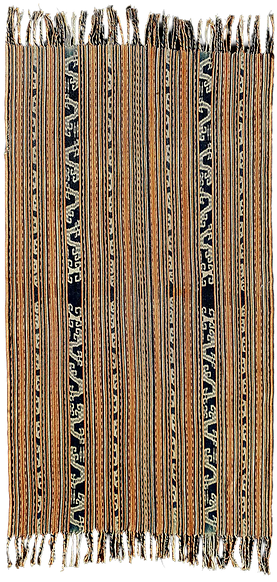
Man's wrap (beti naek)
West Timor, Insana or Ambenu
1920–1940
Warp ikat, hand-spun cotton
86 x 156 cm
Gift of Dr Peter and Ineke ten Hoopen
HKU.T.2025.2745
The design of this men’s wrap, featuring multiple stripes and duck motifs, suggests that the textile originates from the Atoni border regions of Belu—Biboki, Insana, Amanatun or the Oecusse (Ambenu) semi-exclave of Timor-Leste. The textile was decorated using only vegetable dyes, including the yellow and pastel green pinstripes. The indigo is deeply saturated and meticulously controlled, with sharp outlines and no visible dye seepage—a characteristic for which Insana is known. This aspect supports an attribution to Insana, though the asymmetry makes Oecusse (Ambenu) another possibility. The mirrored motif pairs are subtly hidden, creating two distinct forms of asymmetry, which is an unusual feature in wraps of this type. While the two panels are typically mounted as mirror images, in this case they are aligned in the same direction. Moreover, the seam does not run down the middle, but 40 cm from one outer selvedge and 45 cm from the other. Part of the warp was transposed from one panel to create this asymmetry—an important desideratum in dualist Austronesian cosmology, where complementarity signifies wholeness, balance and harmony.
男士腰布 (beti naek)
西帝汶, Insana縣 或 Ambenu縣
1920–1940 年
伊卡絣織,手紡棉線
86 x 156 厘米
Dr Peter and Ineke ten Hoopen 惠贈
HKU.T.2025.2745
這件男士腰布的設計以多條紋與鴨子紋樣為特徵,表明其可能源自印尼貝盧縣 Atoni民族居住的邊境地區,包括 Biboki 、 Insana 、 Amanatun ,或東帝汶的 Oecusse ( Ambenu )半飛地。這塊紡織品上的所有花紋,包括黃色和淡綠色的細條紋,僅使用植物染料染製。布料上的靛藍色濃郁飽和,染料工藝控制精準,輪廓分明無暈染,正是 Insana地區標誌性的工藝特色。這一點佐證了其產自 Insana的可能性,然而圖案的不對稱性亦使東帝汶的Oecusse (Ambenu) 地區成爲另一合理推測的產地。布料中鏡像對稱的紋樣被巧妙隱去,形成兩種獨特的不對稱形態,在此類腰布中非常罕見。通常情況下,兩塊裁片會以鏡像對稱方式拼接,但此件作品卻使用同向排列。此外,其接縫並非置中,一側距離布邊40厘米,另一側45厘米。爲了實現這種不對稱效果,部分經線在兩片裁片間交錯移位。這種手法深植於南島民族宇宙觀二元論,其中互補性象徵著完整、平衡與和諧。

Sarong (tais)
West Timor, Amarasi, Atoni people, Oekabiti clan
ca. 1950
Warp ikat, fine commercial-grade cotton
72 x 95 cm
Gift of Dr Peter and Ineke ten Hoopen
HKU.T.2025.2746
This finely woven traditional Amarasi ceremonial sarong features a richly decorated field of white bands on a morinda-red background, showcasing the kai e’ne of the kaif motif—symbolising ancestral connection—in a form distinctive to the Oekabiti clan. The textile consists of three panels joined so precisely that the seam is barely visible, and more easily discovered by stroking the cloth. The middle panel features two kai e’ne motifs, while each side panel displays one complete motif flanked by two outward-facing halves. Narrow accent stripes in black-and-white float weave (sotis) and fine pinstripes in green and red pre-dyed commercial yarns—typical of early 20th-century Timorese cloths—enhance the composition.
紗籠 (tais)
西帝汶, Amarasi公國 , Atoni 族裔, Oekabiti 氏族
約 1950 年
伊卡絣織,優質商用級棉布
72 x 95 厘米
Dr Peter and Ineke ten Hoopen 惠贈
HKU.T.2025.2746
這件工藝精湛的傳統 Amarasi公國在儀式所穿著的紗籠,以檄樹紅為底,飾以豐富的白色帶狀紋飾,展現出Oekabiti 氏族獨有的「 kaif 」紋樣,其中「 kai e’ne 」圖案象徵著與祖先的連結。這件紡織品由三片裁片拼合而成,接縫精密至極,肉眼難辨,需以手觸摸方能察覺。中間的布料上呈現兩組「 kai e’ne 」圖案,兩側布片則各飾一組完整紋樣,並都配有向外的對稱半形紋。採用黑白浮織法裝飾的窄條紋,以及由預染的商業紗線織就的紅綠細條紋,是20世紀早期帝汶紡織品的典型特徵。這種編排完善了整幅織物的構圖。

Man's wrap (mau naek)
West Timor, Bokong, North Amanatun
ca. 1945
Warp ikat, hand-spun cotton
108 x 195 cm
Gift of Dr Peter and Ineke ten Hoopen
HKU.T.2025.2747
The textile’s central band is decorated with eight large river fish drawn in great detail. The secondary ikated bands carry human figures that appear to be wearing the Meo warrior’s headgear, pilu saluf. Surprisingly, the fish motif does not originate in the coastal areas, but only occurs in the mountain district of North Amanutan, where a small number of communities weave in this style. While there are no fish-filled rivers or waterways running through North Amanatun, there is a legend that ‘river fish are a favourite food of crocodiles. They are so eager to feed on them that they sometimes venture up the Benanain River, leading from the sea, until they reach the foothills of our mountains, where during the rainy season they can find abundant fish. A long time ago, a saltwater crocodile helped our great ancestor to reach our island, carrying him on his back. That is why we so often represent, in the garments woven by our women, this food so coveted by the crocodiles’.
The microphotography of this object shows the use of the wildly irregular yarns characteristic of the period before circa 1925, and rarely encountered in younger ikat. Its colours are a bit washed out, though enough contrast remains to indicate the fascinating, well-executed pattern with its uncommon link to a specific region. The cloth contains three different shades of blue: dark pinstripes, a medium-toned midfield and noticeably paler secondary ikat bands. The meticulous detail includes very fine stippling along the fishes’ backs, achieved through countless tiny, tightly bound ties. This level of craftsmanship suggests that, for women on the island and in the broader region, textile production did not follow strict economic guidelines. Rather, it served as a platform to showcase their skills, as demonstrated by the weaver’s technically impeccable execution of the motif.
男士腰布 (mau naek)
西帝汶, Bokong村 ,Amanatun公國的北部地區
約 1945 年
伊卡絣織,手紡棉線
108 x 195 厘米
Dr Peter and Ineke ten Hoopen 惠贈
HKU.T.2025.2747
這件織物的中央飾帶裝飾著八條精細描繪的大型河魚紋樣。次要的伊卡絣織帶則飾有頭戴「 Meo 」戰士傳統頭飾「 pilu saluf 」的人形紋樣。令人驚奇的是,以魚爲主題的紋飾並非源自沿海區域,而是只出現於Amanutan北部山區—當地僅有少數群落保留這種織造風格。儘管Amanutan北部境內並無魚群豐饒的河流或水道,但卻流傳著一則傳說:「河魚是鱷魚最喜愛的食物。牠們為覓食不惜溯游而上,甚至有時會冒險游到通往海洋的 Benanain 河,直至抵達我們山腳下的地區,每逢雨季,牠們可以在這裏尋覓到豐沛的魚群。遠古時期,一隻鹹水鱷曾馱載著我們偉大的先祖登陸本島。正因如此,我們總在婦女編織的衣料上呈現這些令鱷魚垂涎的食物圖案。」
通過微距攝影可見,此織物使用的紗線具有約1925年前粗細自然的特質,在後期伊卡絣織作品中極爲罕見。其色澤雖已淡褪,殘存的對比度仍足以展現精妙紋樣以及它與特定地域的罕見聯繫。織物蘊含三種深淺不一的藍色:深色的細條紋、中等色調的中段區域與明顯較淺色的次要伊卡絣織帶。細部處理極為考究,包括魚背上的細密點紋,這是透過無數緊密綁紮的微小線頭製作而成。如此精湛的工藝水平表明,對該島以至更廣地區的女性而言,織品生產並非純粹遵循嚴苛的經濟準則。相反,紡織是她們展現技藝的平台。織工在主題紋樣上無可挑剔的技術呈現,正是最好的證明 。

Man's blanket (hinggi)
East Sumba, probably Kanatang
early 20th century
Warp ikat, hand-spun cotton
101 x 236 cm
Gift of Dr Peter and Ineke ten Hoopen
HKU.T.2025.2748
This antique hinggi is woven in a variation of the hondu kappit style featuring six motif replications per panel, rather than the typical eight. The central motifs depict skull trees flanked by male figures with pronounced genitalia. The yellow accents were created through the ndata process, in which the colour was applied to sections of the warp during the weaving rather than daubed in afterward. The midfield, kundu duku, displays a subtle asymmetry introduced by the red, snake-like motifs. For the cloth to be axially symmetric, the motifs above and below the central axis would need to mirror each other—but in this case they are identical, creating a hidden imbalance.
男⼠毯⼦ (hinggi)
東松巴,可能是 Kanatang地區
20 世紀初
伊卡絣織,手紡棉線
101 x 236 厘⽶
Dr Peter and Ineke ten Hoopen 惠贈
HKU.T.2025.2748
這件古董「 hinggi 」採用了「 hondu kappit 」風格的變體織法,每片裁片上的紋樣僅重複六次,而非典型的八次。中心主題描繪了骷髏樹,兩側輔以生殖器突出的男性形象。點綴其間的黃色細節以「 ndata 」工藝製作,此技藝是在織造過程中將色彩施於經線上,而非織成後再行塗繪。名爲 「 kundu duku 」的中段區域因紅色蛇形紋樣的佈局而呈現出一種微妙的不對稱感。若要使織物達到軸對稱,中心軸線上下方的紋樣應互爲鏡像,然而此作品中的紋樣卻完全一致,從而構成隱匿的失衡感。

Wela (sarong)
Solor archipelago, Kedang region of Eastern Lembata;
probably made on the island in Kalikur,
or made of ikated skeins from eastern Adonara
1915–1940
Warp ikat, largely hand-spun cotton
71 x 192.5 cm
Gift of Dr Peter and Ineke ten Hoopen
HKU.T.2025.2749
This textile is a Kedang bridewealth sarong, intended to be given to the groom’s family in exchange for items considered male, such as gold and livestock. Bridewealth sarongs, significantly longer than everyday garments, were rarely worn. When used in ceremonies, they would be folded and worn as a two-tiered sarong to fit the bride. There was a taboo on weaving in the Kedang region until World War II, with the only exception being the coastal village of Kalikur, which was inhabited by Muslim immigrants. Such bridewealth sarongs were also imported from Ili Api and eastern Adonara, where they were specially made with indigo midfields. The weaving shows a plain indigo midsection and two panels with ikated bands of varying width displaying a variety of geometric motifs, some of which may represent aquatic animals. A few narrow stripes in fine yellow commercial yarn have been twined for greater thickness. Similar cloths contain commercial yarns, likely sourced from a Chinese shop, toko, used for both accent stripes and twining. The Balauring port in Kedang had an established Chinese trading community as early as the 1900s.
紗籠 (sarong)
索洛群島,東倫巴塔 Kedang 地區;
可能製作於 Kalikur 島,或採用東阿多納拉島的伊卡絣織紗線
1915–1940 年
伊卡絣織,主要為手紡棉線
71 x 192.5 厘⽶
Dr Peter and Ineke ten Hoopen 惠贈
HKU.T.2025.2749
此織物為 Kedang 地區作爲新娘彩禮的紗籠,需贈予新郎家族以交換被視為男性之物的金和牲畜等。這類紗籠長度遠超日常服飾,甚少實際穿著。儀式使用時需對折成雙層以適應新娘身形。二戰前,Kedang 地區嚴禁織布,穆斯林移民聚居的沿海村落 Kalikur 除外。此類彩禮紗籠亦從 Ili Api 與東阿多納拉傳入,那裏的紗籠特別以靛藍染製中央區域。此件織物中央區域為素面靛藍色塊,兩側裁片飾有以伊卡絣織工藝織就的寬窄不一的幾何紋樣,部分紋樣可能象徵水生動物。數道採用精細商業黃紗的窄條紋通過絞織工藝增加厚度。同樣含有商業紗線的相似布料很可能購自華人店鋪,用於點綴條紋和絞織。早在1900年代,Kedang地區的 Balauring 港口已建立了華人貿易社群。

Man's shawl (semba)
Flores, Lio, Nggela
ca. 1950
Warp ikat, fine hand-spun cotton
55.5 x 146 cm
Gift of Dr Peter and Ineke ten Hoopen
HKU.T.2025.2750
This shoulder cloth is a male ritual leader’s shawl, luka semba, worn once a year by high-ranking men at dances on the occasion of the four-day adat feast. The exceptionally tight weaving produces a strong pattern in subtle hues, making this textile an exemplary representation of the fine Nggela technique. The design features the selenda sinda motif, a patola-style jilamprang design with tumpal borders. It closely resembles an almost perfect patola imitation featuring three shades of morinda red and violet-black (red with indigo), with a few accents in pale indigo.
男⼠披肩 (semba)
弗洛勒斯島,Lio織造區 ,恩蓋拉
約 1950 年
伊卡絣織,手紡細棉線
55.5 x 146 厘⽶
Dr Peter and Ineke ten Hoopen 惠贈
HKU.T.2025.2750
此件名爲「 luka semba 」的肩布是男性儀式領袖的披肩,每年僅在為期四天的「習慣法」盛宴上由高階男性配戴。異常緻密的織法在微妙色調中勾勒出鮮明紋樣,成為精細的恩蓋拉織造工藝的典範之作。披肩紋樣以「 selenda sinda 」為核心主題,採用「patola 」風格的「 jilamprang 」設計,並以「 tumpal 」裝飾邊框。織品近乎完美地復刻了「patola」紋樣,運用三種深淺不一的檄樹紅與紫黑(紅色和靛藍的混合色),並以淺靛藍色點綴。

Ceremonial cloth (pua kumbu)
Borneo, Sarawak, Balleh River system, Iban people
ca. 1950
Warp ikat, coarse hand-spun cotton
105 x 179 cm
Gift of Dr Peter and Ineke ten Hoopen
HKU.T.2025.2751
This cloth displays two panels with large human figures representing spirits, antu. Their hands are raised, wearing feathered headgear and ear pendants. The borders at the extremities most likely represent lizards. The striking imagery comes into its own through good weaving in hand-spun yarn with natural dyes. One side has lost much of its colour, while the other, though somewhat faded, remains visually striking and representative of the style. Both the warp and weft are made from double-ply threads, laid in parallel rather than twined.
儀式⽤布(普阿昆布)
婆羅洲,砂拉越,巴列河流域,伊班族
約 1950 年
伊卡絣織,粗手紡棉線
105 x 179 厘⽶
Dr Peter and Ineke ten Hoopen 惠贈
HKU.T.2025.2751
此織物呈現兩片飾有象徵神明「antu」的巨型人形紋樣的裁片。圖中人物雙手高舉,頭戴羽飾,耳懸墜飾。布匹邊緣紋樣很可能代表蜥蜴。透過精湛的手紡技藝與天然染料,使這組突出的圖像得以完美展現。織物一側色澤已大量褪去,另一側雖略有褪色,仍保持著視覺衝擊力,及該風格的代表性。經緯線由雙股紗線平行排列組成,而非絞織而成。

Men’s wrap (hi’i)
Savu
1930–1950
Warp ikat, extremely fine, double-ply and hand-spun cotton
86 x 148 cm
Gift of Dr Peter and Ineke ten Hoopen
HKU.T.2025.2752
This finely woven cloth displays a field decorated with seven main ikated bands, interspersed with numerous ikated and plain stripes. The primary motif is a floral design of European inspiration, derived from needlework patterns. The asymmetry is expressed by four of the main ikated bands on one panel and three on the other. The floral motifs are also inverted and the main ikated bands are interspersed with narrower bands carrying a lozenge motif known as a boda. The indigo tone is relatively light, likely a deliberate choice by the weaver, as the cloth shows only moderate fading. The crisp, angular drawing style is unusual for Savu textiles.
男⼠腰布 (hi’i)
薩武群島
1930–1950 年
伊卡絣織,雙股手紡極細棉線
86 x 148 厘⽶
Dr Peter and Ineke ten Hoopen 惠贈
HKU.T.2025.2752
此件精織織物以七條伊卡絣織飾帶構成主體紋樣,其間穿插多條伊卡絣織與素面條紋。核心圖案為受歐洲刺繡圖案啟發的花卉紋樣。織物的一片裁片飾有四道伊卡絣織帶,而另一片僅有三道,呈現出不對稱的設計。花卉紋樣均採用倒置排列,主伊卡絣織飾帶之間更穿插帶「boda」菱紋的窄幅飾帶。布料的靛藍色調相對淺淡,應是織者刻意為之,因為織物僅有輕微褪色。這種稜角分明的繪製風格在薩武群島織品中相當罕見。

Men’s shawl (selendang)
Savu, Raijua, Hubi Ae matrilineal group
1940–1950
Warp ikat, hand-spun cotton
98 x 157.5 cm
Gift of Dr Peter and Ineke ten Hoopen
HKU.T.2025.2753
This shoulder cloth is a gentleman’s shawl, Hi’i worapi, woven in three colours—dark indigo, morinda red and the cotton’s natural tone. It features decorative motifs including flowers (boda) and wavy lines that reference designs found on lontar container handles (kekama haba). The textile consists of two panels, one with four major bands, the other with five, which is the unequal number prescribed by adat.
男⼠披肩 (selendang)
薩武群島,Raijua,Hubi Ae母系群體
1940–1950 年
伊卡絣織,手紡棉線
98 x 157.5 厘⽶
Dr Peter and Ineke ten Hoopen 惠贈
HKU.T.2025.2753
這是一件名爲「Hi'i worapi」的男士披肩,採用三種顏色包括深靛藍色、檄樹紅色以及棉線原色織成。披肩以花卉圖案「boda」與棕櫚葉容器提柄上所示的波浪線條「kekama haba」作爲主要紋飾。此織物由兩片裁片組成,一片飾有四道主紋帶,另一片則有五道。這種不對稱的數量配置符合「習慣法」這種傳統習俗的規定。

Men’s blanket (hinggi)
East Sumba
ca. 1940
Warp ikat, hand-spun cotton
99.7 x 226 cm
Gift of Dr Peter and Ineke ten Hoopen
HKU.T.2025.2754
A remarkable aspect of this hinggi‘s design is its cleverly disguised asymmetry. The dyer crafted an intricate midfield that, at first glance, seems symmetrical, with the top and bottom mirroring each other. However, the middle of the three bands positioned on the axis is inherently asymmetric. It features a wavelike pattern with peaks and troughs that do not mirror one another. This type of hidden asymmetry is found almost exclusively in early specimens and seems to have fallen out of fashion around 1940, or more specifically in 1942, when the Japanese invasion of Indonesia led to a general trend towards simplified designs.
男⼠毯⼦ (hinggi)
東松巴
約 1940 年
伊卡絣織,手紡棉線
99.7 x 226 厘米
Dr Peter and Ineke ten Hoopen 惠贈
HKU.T.2025.2754
這款「hinggi」設計最精妙之處在於其巧妙隱藏的非對稱性。染匠在中心區域所創造出的繁複圖案,初看時上下鏡像對稱,實則位於中軸線上三條飾帶的中間部分,本質上是不對稱性的。其波浪紋樣的波峰與波谷並非呈鏡像對映。這種隱藏的非對稱手法幾乎僅見於早期作品。在1940年左右已經過時,或更精確地説,是在1942年,隨著日本入侵印度尼西亞,導致設計風格普遍趨於簡化。

Men’s blanket (hinggi)
Sumba
1970s
Warp ikat, machine-made yarn, mix of natural and synthetic dyes
110 x 267 cm
Gift of Dr Peter and Ineke ten Hoopen
HKU.T.2025.2755
This cloth is typical of Sumbanese ikat made in the 1970s and later, intended for foreign buyers. It uses traditional motifs, but in an arrangement that differs from those in earlier specimens. The narrow midfield is left plain, rather than decorated, which means that the dyer did not have to shift the warp out of and into position on the warp beam, saving herself a time-consuming procedure. The ikat however is first rate, intricate and crisp, with perfect alignment, showing great technical ability.
男⼠毯⼦ (hinggi)
松巴
1970 年代
伊卡絣織,機紡紗線,天然與合成染料混合物
110 x 267 厘⽶
Dr Peter and Ineke ten Hoopen 惠贈
HKU.T.2025.2755
此織物是1970年代及之後,專為外國買家製作的典型松巴伊卡絣織作品。織物雖沿用傳統紋樣,但佈局方式與早期樣品迥異。狹窄的中段區域保留素面,沒有進行裝飾,意味著染匠無需在經軸上反覆調整經紗位置,從而省去了一道耗時的工序。然而此伊卡絣織仍屬上乘品質,圖案繁複清晰、對位精準,展現出卓越的技術水準。

Men’s blanket (hinggi)
East Sumba
late 19th to early 20th century Warp ikat, hand-spun cotton
141 x 260 cm
Gift of Dr Peter and Ineke ten Hoopen
HKU.T.2025.2756
The design of this textile shows a subtle asymmetry, created by minute devices placed in the central band, kundu duku, where four red crosses appear without counterparts on the opposite side of the cloth’s horizontal axis. The kundu duku is decorated with the patola-inspired patola ratu motif, which, due to its complexity, is used for hiding keys that produce asymmetry. The dyers of such cloths understood how onlookers process visual information and recognised that their tendency to generalise often leads them to overlook small deviations from expected regularity. The cloth has a classic nine-band field division, with deer in the widest bands, horses and milkweed plants in the second widest and birds in the third. All of these motifs, except for the milkweed (wanggakoli), are reserved for the nobility. The birds likely represent cockatoos, a non-exclusive hallmark of the court of Rende.
男⼠毯⼦ (hinggi)
東松巴
伊卡絣織,手紡棉線
141 x 260 厘⽶
Dr Peter and Ineke ten Hoopen 惠贈
HKU.T.2025.2756
此織物的紋樣設計呈現一種隱約的非對稱性,此效果是由名爲「kundu duku」的中心飾帶上的微小圖案創造出來的。四組紅色十字紋樣在織物橫軸的另一側沒有對應的圖案。中心飾帶上的「patola ratu」紋樣靈感源自「patola」織品,其繁複結構常用於隱藏產生非對稱性效果的關鍵元素。當時的染匠深諳觀者處理視覺信息的原理,洞悉人們傾向概括整體而忽略細微的規律偏差。此毯採用經典的九段式佈局:最寬飾帶以鹿紋為主,次寬飾帶呈現馬匹與乳草植物(wanggakoli),第三飾帶則飾以飛鳥。除乳草紋外,其餘紋樣皆為貴族專用。其中鳥紋可能象徵鳳頭鸚鵡,此紋樣為「Rende」宮廷的一個非專屬標誌。
Address: 90 Bonham Road, Pokfulam, Hong Kong View the location on Google Maps
Tel: (852) 3917 5500 Email: museum@hku.hk
© 2026 by University Museum and Art Gallery, HKU. All Rights Reserved


