DIGITAL EXHIBITIONS2

捏出個大唐:
長沙窯瓷塑展
Pinching Out a Tang Dynasty:
Changsha Kiln Ceramic Figurines Exhibition
Curated by Kitty Lam
策展人:林慧琳


唐代長沙窯是唐代中晚期盛極一時的著名南方民間青瓷窯場。它打破了當時「南青北白」的單一色調,首創高溫釉下多彩工藝,並將詩詞書法、民間繪畫融入瓷器裝飾,是見證唐代海上絲綢之路繁盛的重要外銷瓷窯。長沙窯燒製的產品種類豐富、造型生動,其中瓷塑作品尤具特色,兼具實用、娛樂與審美功能於一體。
這些瓷塑以生動鮮活的形象,刻畫了唐代社會的人物、動物等多種題材,成為反映當時社會生活、風俗習慣與精神世界的重要物質載體,構成了一幅立體而豐富的唐代生活畫卷,也為研究唐代物質文化、民俗信仰與視覺表達提供了重要實物資料,在中國乃至世界陶瓷史上留下獨特而鮮明的印記。
香港大學美術博物館呈獻「捏出個大唐:長沙窯瓷塑展」線上專題展覽,從小朋友的視角出發,以問答形式,透過長沙窯的瓷塑作品,由淺入深,帶領觀眾走進大唐的生活。
The Changsha Kiln was a renowned southern folk celadon kiln that flourished during the mid-to-late Tang dynasty. It broke away from the monochrome tradition of "green wares in the south, white wares in the north," pioneering high-temperature underglaze polychrome decoration and incorporating poetry, calligraphy, and folk painting into its ceramic designs. As an important export kiln, it bears witness to the prosperity of the Tang dynasty's Maritime Silk Road. The Changsha Kiln produced a rich variety of wares with lively forms, among which its ceramic figurines are particularly distinctive, combining practical, entertaining, and aesthetic functions in one.
These ceramic figurines vividly depict figures, animals, and other subjects from Tang society. They serve as important material evidence of the social life, customs, and spiritual world of the time, forming a three-dimensional and richly textured picture of Tang life. They also provide valuable physical materials for the study of Tang material culture, folk beliefs, and visual expression, leaving a unique and distinctive mark on the history of ceramics in China and beyond.
The University Museum and Art Gallery, The University of Hong Kong, presents "Pinching Out a Tang Dynasty: Changsha Kiln Ceramic Figurines Exhibition," an online special exhibition, adopts a child's perspective and a question-and-answer format, progressing from the simple to the profound, to lead audiences into the life of the Great Tang through the Changsha Kiln's ceramic sculptures.
目錄
Contents
我們屬於什麽範疇?
What category do we belong?
長沙窯出產的瓷塑涵蓋多種範疇。你們能猜到都有哪些嗎?
Changsha Kiln ceramic figurines covered many different categories. Can you guess what they were?
我們是用來做甚麼的?
What were we made for?
瓷塑往往造型各異。你猜猜,我們是為了甚麼而製作的呢?
Ceramic figurines are often designed in different shapes. Guess what we are made for.
如何分辨我們?
How to tell us apart?
有些瓷塑造型相同,它們之間有甚麼分別?
Some ceramic figurines were designed in the same shape. What are the differences between them?
我們是如何被製造出來的?
How were we made?
它的生產過程是如何的?又運用了怎樣的製作技巧呢?
What is its production process like? What kind of crafting techniques are used?
我們為甚麼深受大家喜歡?
Why were we so popular?
為甚麼古人喜歡製作當時被視為外來動物的獅子呢?
Why did ancient people prefer making lions?
我們屬於什麽範疇?
What category do we belong?
長沙窯瓷塑造型大多形體小巧,高度多在 3 厘米左右,較大者頗為罕見。儘管體積不大,塑造手法卻生動而概括。從造型來看,瓷塑大致可分為人物類與動物類;其中動物類又可細分為走獸、禽鳥、魚龜及神話傳說四類。以下就讓我們逐一介紹不同類型的瓷塑吧!
Changsha Kiln figurines are mostly small in scale, usually around 3 cm in height, with larger examples being relatively rare. Despite their small size, they are vividly and concisely modelled. In terms of form, these figurines can be broadly divided into two categories: figures and animals. The animal category can be further divided into four types: beasts, birds, fish and turtles, and mythological creatures. Let us now introduce the different types of figurines one by one.
人物類
Figures
長沙窯人物類瓷塑涵蓋孩童、仕女、樂俑、胡人、僧侶等多種形象,直接反映唐代社會各階層人物的面貌、活動與精神世界,成為今人理解當時社會生活、風俗信仰與文化交融的直觀載體。本次展覽將介紹館藏中的四件展品。
Figurative ceramic sculptures from Changsha ware encompass a variety of images, including children, court ladies, musician figurines, Hu people, and monks. They directly reflect the appearance, activities, and inner world of people from various social strata in the Tang Dynasty, serving as an intuitive medium through which people today can understand the social life, customs and beliefs, and cultural exchange of that era. This exhibition will introduce four objects from the museum's collection.
馴象鎮紙
Paperweight with Figure and Tamed Elephant

馴象鎮紙 Paperweight with Figure and Tamed Elephant

馴象鎮紙 Paperweight with Figure and Tamed Elephant
馴象鎮紙 Paperweight with Figure and Tamed Elephant
Tang Dynasty 唐
Chang Sha Kiln 長沙窯
Underglaze brown-and-green 釉下褐綠彩
UMAG.1683.10
你看,這件瓷塑上有一個人,正摸著一隻躺下來的大象。大象躺在地上,好像很舒服。
咦,大象不是住在森林裡嗎?牠為什麼會來到唐朝呢?原來,大象是別的國家送給唐朝的禮物。送大象來的國家,多在今天的東南亞一帶。
唐朝的皇宮裡養過大象,主要在國家重大典禮上展示,用來顯示國家的威儀。那麼,瓷塑上這位坐著的人是誰?他很可能是跟著大象一起來的馴象師,也就是負責照顧大象的人。
一件小小的瓷塑,不只描繪了一個人和一隻象,更讓我們看到唐朝和外國之間的來往。
Look at this ceramic figurine. A person is gently touching an elephant that is lying down. The elephant rests on the ground, looking quite comfortable.
Wait — don't elephants live in the forest? So why would one appear in the Tang Dynasty? It turns out that the elephant was a gift from another country to the Tang court. Most of the countries that sent elephants were in what is now Southeast Asia.
The Tang palace kept elephants, mainly to display them at major state ceremonies to show the nation's dignity. So who is the seated figure on the figurine? He was most likely an elephant handler who came along with the elephant — that is, someone responsible for looking after it.
This small ceramic piece does more than show one person and one elephant. It gives us a glimpse of the exchanges between the Tang Dynasty and foreign countries.


動物類
Animals
動物類瓷塑的立體造型幾乎均兼具實用功能,多為文房用品,如硯滴、鎮紙等,體現了民間對書寫與教育的重視,部分亦用作兒童玩具。其形象多為微型動物,且在造型上有所選擇與區分。品類數以百計,但一般可分為四大類:走獸類、禽鳥類、魚龜類以及神話傳說類。
The three-dimensional animal figures in ceramic figurines almost all served a practical function as well, mostly as scholar's desk items such as ink droppers and paperweights, reflecting the popular emphasis on writing and education; some were also used as children's toys. Their forms are mostly miniature animals, with deliberate selection and differentiation in their modelling. There are hundreds of types, but can generally be divided into four major categories: quadrupeds, bird figures, fish and turtle figures, and mythical auspicious animals.
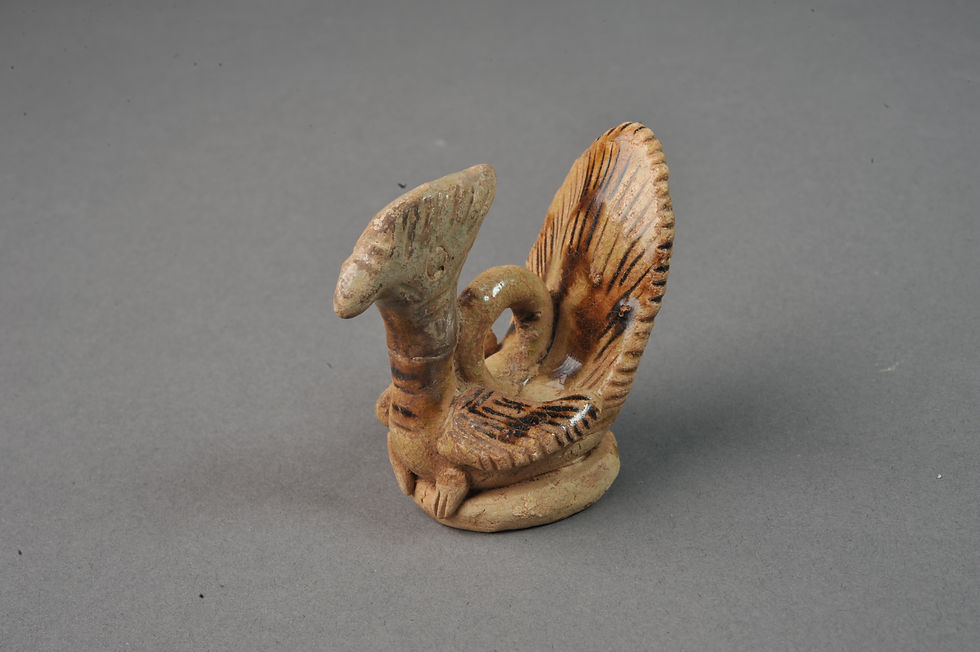

禽鳥類
Birds

鴿形玩具 Pigeon Shaped Toy

鴿形玩具 Pigeon Shaped Toy

鷹形瓷塑 Eagle Shaped Ceramic Figurine
鴿形玩具 Pigeon Shaped Toy
Tang Dynasty 唐
Chang Sha Kiln 長沙窯
Underglaze brown-and-green 釉下褐綠彩
UMAG.1806.16, 21, 42
UMAG.1683.3, 21
這些小小的瓷塑,有鳥(UMAG.1806.21)、有鸚鵡(UMAG.1806.42)、有雞(UMAG.1683.3)、有鴿子(UMAG.1806.16),還有鷹(UMAG.1683.21),它們都來自唐代的長沙窯,造型簡潔傳神。
長沙窯瓷塑中的禽鳥題材小巧生動,多見於玩具、鎮紙及器物裝飾。雀鳥類多作斂翅立姿,機警靈動;鸚鵡形鎮紙雙眼圓睜,身形緊縮,羽翅以數道線刻表現,栩栩如生;帶紐雞體態圓渾,尖嘴小冠;鴿子形似麻雀;鷹常立於樹幹,既似休息,亦如蓄勢待發。
為什麼唐代人這麼喜歡做鳥呢?原來,鷹在傳統文化中象徵勇猛、勝利與英雄,也是家宅的守護神。而鸚鵡在唐代尤其受貴族喜愛,宮中盛行馴養,民間也以鸚鵡為寵物。唐人喜愛鸚鵡,因為牠們美麗能言,而且寓意富貴吉祥。
這些小小的瓷塑,不只造型可愛,更讓我們看到唐朝人對鳥的喜愛,以及鳥在當時文化中的特殊意義。
There are birds (UMAG.1806.21), a parrot (UMAG.1806.42), a chicken (UMAG.1683.3), a pigeon (UMAG.1806.16), and an eagle (UMAG.1683.21) in these small ceramic figures — and they all come from the Changsha Kiln of the Tang Dynasty, with simple and vivid forms.
Bird subjects in Changsha Kiln ceramics are small and lively, often found as toys, paperweights, and vessel decorations. Sparrow-like birds mostly stand with folded wings, alert and nimble. The parrot-shaped paperweight has round, wide-open eyes and a compact body, with its wings rendered in a few incised lines, true to life. The loop-handled chicken has a rounded body, a pointed beak, and a small comb. The pigeon resembles a sparrow. The eagle often stands on a tree trunk, as if resting, yet also as if ready to strike.
Why did Tang people love making birds so much? It turns out that in traditional culture, the eagle symbolises bravery, victory, and heroism, and also serves as a guardian of the home. Parrots, meanwhile, were especially favoured by the aristocracy in the Tang Dynasty, and were commonly kept in the palace; common people also kept parrots as pets. Tang people loved parrots for their beauty, their ability to speak, and because they symbolised wealth and good fortune.
These small ceramic figures are not just charming in form. They also give us a glimpse of how much Tang people loved birds, and the special meaning birds held in the culture of that time.


我們是用來做甚麼的?
What are we made for?
瓷塑往往造型各異:有的帶孔,有的附底座,有的帶環,有的似動物,有的又甚麼都不像。你猜猜,它們都有哪些用途?又為何會有這樣的設計?
Ceramic figurines often come in widely varied forms: some have holes, some have bases, some have rings, some resemble animals, and some look like nothing recognizable at all. Can you guess what they were used for? And why were they designed in such ways?


鎮紙
Paperweight

臥獅鎮紙 Crouching Lion-Shaped Paperweight

臥獅鎮紙 Crouching Lion-Shaped Paperweight

系紐獅形鎮紙 Looped Lion-Shaped Paperweight
臥獅鎮紙 Crouching Lion-Shaped Paperweight
Tang Dynasty 唐
Chang Sha Kiln 長沙窯
Underglaze brown-and-green; Celadon
釉下褐綠彩;青釉
UMAG.1806.21, 23, 26, 28, 29
如果大家細心留意一下這寫瓷塑,會發現它們不是有底座,就是有系紐設於背上。它們的功能是什麽呢?其實這些都是鎮紙。鎮紙是做什麼的呢?寫字或看書的時候,紙張或書冊容易被風吹動、捲起來,這時候只要用鎮紙壓住,就能把紙張壓平。鎮紙最早出現於戰國,盛行於漢代,最初用以壓席角,後隨家具更迭,逐漸演變為文房鎮紙。
長沙窯瓷塑中出現大量鎮紙,題材以動物為主,尤以獅形最常見,亦有狗、鳥、魚、龜等。它們的底部平整、重心穩定,多作圓形或方形底座,方形底座隨造型倒角,避免磕碰劃傷紙張,尺寸與重量合於人體工學,便於單手拿放。
鎮紙的造型設計分坐立型、伏臥型與系紐型三種,其中系紐型頗具代表性:在動物頂部或背部捏出圓紐以供穿繩。為什麼要這樣設計呢?因為唐代文人往返書齋、官署或旅途時,可以將鎮紙懸於行囊、筆架等處,隨取隨用,不易丟失,亦節省案頭空間。
這些小小的鎮紙,不只造型可愛,更讓我們看到唐朝人讀書寫字的生活智慧,以及他們把動物形象融入日常用具的巧思。
If you look closely at these ceramic figurines, you will notice that they either have a base or a loop set on their backs. What are they for? In fact, they are all paperweights. What is a paperweight for? When writing or reading, paper or books can easily be blown by the wind or roll up. A paperweight is used to hold them down and keep them flat. Paperweights first appeared in the Warring States period and became widespread in the Han Dynasty. They were originally used to weigh down the corners of mats, and later, as furniture changed, gradually evolved into scholar's desk paperweights.
Large numbers of paperweights appear among Changsha Kiln ceramics, mostly with animal subjects. The lion form is the most common, alongside dogs, birds, fish, and turtles. They have flat bases and a stable centre of gravity, mostly with round or square bases. Square bases have their corners chamfered to match the form, avoiding bumps and scratches to the paper. Their size and weight follow ergonomic principles, making them easy to pick up and put down with one hand.
Their designs fall into three types: seated/upright, crouching/lying, and loop-handled. The loop-handled type is especially representative: a round loop is pinched on the animal's head or back for threading a cord. Why was it designed this way? Because when scholars travelled between their study, government office, or on journeys, they could hang the paperweight on their bag or brush stand, ready to use at any time, not easily lost, and saving space on the desk.
These small paperweights are not just cute. They also show us the everyday wisdom of Tang people when reading and writing, and their cleverness in integrating animal forms into daily tools.


如何分辨我們?
How to tell us apart?
有些帶有系紐的瓷塑即使造型相同,卻被定義為不同功能:有些被認為是鎮紙,另一些則被視為玩具。它們之間的區別是什麼?又是如何區分的?以下讓我們以小狗瓷塑為例,與大家一起探討。
Some ring-handled ceramic figurines, even when identical in form, have been defined as having different functions: some are considered paperweights, while others are regarded as toys. What is the difference between them, and how are they distinguished? Let us take dog and lion figurines as examples to explore this question together.
系紐鎮紙與玩具的區別
The difference between loop-handled paperweights and toys

狗形鎮紙 Dog Shaped Paperweight

狗形鎮紙 Dog Shaped Paperweight

狗形玩具 Dog Shaped Toy
狗形鎮紙 Dog Shaped Paperweight
Tang Dynasty 唐
Chang Sha Kiln 長沙窯
Underglaze brown-and-green; Celadon
釉下褐綠彩;青釉
UMAG.1806.14
UMAG.1683.13
鎮紙的底部是平的,重心很穩,所以放在桌上不會倒。它的底座通常是圓形或方形。方形的底座會把角修圓,這樣才不會撞到或刮傷紙張。鎮紙的大小和重量也剛剛好,一隻手就能拿起來。
牽引旋轉式玩具大多是鳥或狗的樣子,背上中間有一個小紐,可以用來穿繩子。玩的時候,把彩色的繩子綁在小紐上,再轉動繩子,瓷塑就會跟著轉動或搖擺,看起來就像鳥在飛,或是動物在繞圈跑。這種玩具把不會動的瓷塑,變成有故事的小遊戲,不但能讓小朋友發揮想像力,也能看出唐代長沙窯的工匠很了解小朋友喜歡怎麼玩。
A paperweight has a flat bottom and a very steady centre, so it will not fall over on the desk. Its base is usually round or square. A square base has its corners rounded off, so it will not bump into or scratch the paper. The size and weight of the paperweight are just right — you can pick it up with one hand.
Pull-and-spin toys are mostly shaped like birds or dogs, with a small loop in the middle of the back for threading a string. To play, you tie a coloured string to the loop and spin the string. The ceramic figure then turns or swings, looking just like a bird flying or an animal running in a circle. This kind of toy turns a still ceramic figure into a little game with a story. It not only lets children use their imagination, but also shows that the craftsmen of the Changsha Kiln in the Tang Dynasty understood how children like to play.
我們是怎麽被製造出來的?
How were we made?
從名字上我們可以得知他是一件瓷器。但是它的生產過程是如何的?又運用了怎樣的製作技巧呢?以下就讓我們為大家逐一解答吧!
From the name, we can tell that it is a piece of porcelain. But what was its production process like? And what kind of crafting techniques were used? Let us explain them one by one for you below!
在我們的博物館藏品中,長沙窯瓷塑的造型工藝主要有捏塑成型與綜合成型。其關鍵在於多種技法的共存互補:捏塑成型賦予作品較高的藝術表現力與特色,綜合成型則兼顧實用性與審美性的平衡。這種工藝體系體現了唐代長沙窯作為民間窯場,在藝術追求與商業現實、手工傳統與技術革新之間的不断探索與調整。它既保留了手工製作的溫度與個性,又逐步發展出適應商品經濟的規模化、標準化生產方式,在中國陶瓷史上留下獨具特色的一頁。以下就從捏塑成型與綜合成型分別探討其區別。
Among the pieces in our museum's collection, the shaping techniques of Changsha Kiln porcelain figurines mainly fall into two categories: pinch-forming and composite forming. The key lies in the coexistence and complementarity of multiple techniques: pinch-forming gives the works a high degree of artistic expressiveness and distinct character, while composite forming strikes a balance between practicality and aesthetics. This craft system reflects how, as a folk kiln in the Tang Dynasty, Changsha Kiln constantly explored and adjusted between artistic pursuit and commercial reality, and between handicraft tradition and technological innovation. While preserving the warmth and individuality of handmade production, it gradually developed large-scale, standardized methods suited to the commodity economy, leaving a distinctive page in the history of Chinese ceramics. Below, we will discuss the differences between pinch-forming and composite forming.
捏塑成型工藝
Pinch Forming Technique

狗形瓷塑 Dog Shaped Ceramic Figurine

狗形瓷塑 Dog Shaped Ceramic Figurine
狗形瓷塑 Dog Shaped Ceramic Figurine
Tang Dynasty 唐
Chang Sha Kiln 長沙窯
Underglaze brown-and-green 釉下褐綠彩
UMAG.1683.22
長沙窯是唐代很重要的民間窯場。工匠們在做瓷塑時,最常用的是「捏塑成型」的方法。捏塑就是用雙手直接把瓷泥捏成想要的形狀,做法很自由,所以每件作品都不太一樣。
做一件瓷塑時,工匠通常會按照「先做下面,再做上面;先做主要部分,再做細節」的順序。以狗形瓷塑(UMAG.1683.22)為例,工匠會先拿一團瓷泥,把裡面的氣泡揉掉,再搓出身體的大致形狀。身體做好後,才慢慢捏出頭和四肢,最後用竹籤之類的工具,刻出眼睛、鼻子、毛髮等小細節。
The Changsha Kiln was a very important folk kiln in the Tang Dynasty. When craftsmen made ceramic figurines, they most often used a method called "pinch-forming." Pinch-forming means using your hands to shape the clay directly into the form you want. It is very free, so every piece comes out a little different.
When making a figurine, craftsmen usually follow the order of "first the bottom, then the top; first the main part, then the details." Take this dog figurine (UMAG.1683.22) as an example. The craftsman first takes a ball of clay and kneads it to remove air bubbles, then rolls it into the rough shape of the body. Once the body is done, the head and legs are gradually pinched out, and finally tools like bamboo sticks are used to carve small details such as the eyes, nose, and hair.


我們爲什麽深受大家喜歡?
What were we so popular?
古人為何喜歡塑造當時被視為外來動物的獅子?獅子源自何處?唐代佛教盛行,獅子的傳入是否與佛教有關?獅子又具有哪些象徵寓意?
Why did the ancients choose to depict lions, animals regarded as foreign in their time? Where did lions originate? Did the introduction of lions to China relate to Buddhism, which flourished during the Tang dynasty? What symbolic meanings did lions hold?

太獅少獅形鎮紙Paperweight in the Shape of a Lion and Cubs

太獅少獅形鎮紙Paperweight in the Shape of a Lion and Cubs

獅形鎮紙 Lion Shaped Paperweight
太獅少獅形鎮紙Paperweight in the Shape of a Lion and Cubs
Tang Dynasty 唐
Chang Sha Kiln 長沙窯
Underglaze brown-and-green 釉下褐綠彩
UMAG.1806.41,45
獅子不是中國原本就有的動物。牠們原本住在西亞和中亞一帶,後來經過絲綢之路,在西漢時期傳入中國。
獅子傳入中國後,地位很快變得越來越高,這和佛教的發展很有關係,在佛教藝術中,獅子常被當作吉祥、保護的動物。後來,獅子的吉祥意思越來越豐富。在傳統民俗和建築中,獅子常被用來驅邪避害。獅子有時也會做成一大一小的樣子,叫做「太獅少獅」,意思是希望做官順利、升官發財。
到了唐代,西域各國會送活獅子給唐朝,馴獅表演也變得很流行。獅子慢慢融入中國的裝飾藝術,也成為長沙窯瓷塑喜歡做的題材之一。
Lions are not native to China. They originally lived in West and Central Asia, and later entered China via the Silk Road during the Western Han Dynasty.
After lions were introduced to China, their status rose quickly, and this was closely tied to the spread of Buddhism. In Buddhist art, the lion is often regarded as an auspicious and protective animal. Later, the lion's auspicious meanings grew richer. In traditional folklore and architecture, lions are often used to ward off evil. Lions are sometimes made in pairs, one large and one small, called "grand lion and young lion," meaning wishes for a smooth career and high office.
By the Tang Dynasty, Western regions sent live lions as tribute to China, and lion-taming performances became very popular. The lion gradually merged into Chinese decorative art and became one of the favourite subjects of Changsha Kiln ceramic figurines.
參考文獻
References
-
周紫璇. 2026. “唐代长沙窑瓷塑形态研究.”
-
“唐代的樂器.” 2004. Hkcssst.Net.2013. http://hkcssst.net/web_2013_june/tang/tang_music.html
-
谭敦宁.2007.“浅谈长沙窑瓷塑艺术的抽象特征.” 收藏界: 87–88.
-
“與動物相玉 | 館藏動物造型玉雕與吉祥寓意.” 2020. Nmh.Gov.Tw. 2020. https://journal.nmh.gov.tw/animal/wild-3.html.
Address: 90 Bonham Road, Pokfulam, Hong Kong View the location on Google Maps
Tel: (852) 3917 5500 Email: museum@hku.hk
© 2026 by University Museum and Art Gallery, HKU. All Rights Reserved


